
By Chloe Harrison, Social Media Strategist at Wrapped Agency
How the You Can Ask campaign helped remove barriers to breast screening by building confidence, trust and permission into every touchpoint.
Breast screening saves lives. But for too many women, attending an appointment isn’t as simple as receiving a letter and turning up.
That was the reality behind the You Can Ask campaign.
When we partnered with the West Yorkshire and Harrogate Cancer Alliance, the challenge wasn’t simply to promote breast screening. It was to reach women who are statistically less likely to attend, including women with learning disabilities, women living with severe mental illness and women from culturally diverse communities.
The data behind the challenge was stark.
In 2021, 47% of women with a learning disability attended breast screening, compared with 65% nationally. Women with severe mental illness are also more likely to miss screening appointments, and research has highlighted lower breast screening uptake among some South Asian communities.
This matters because lower screening attendance does not exist in isolation. It contributes to later diagnosis, poorer outcomes and deeper health inequalities. For the NHS and cancer services, improving access to screening is not just a communications challenge. It is a health equity challenge.
So we had to start in the right place.
Not with channels, creative or media planning. With the barrier.
The real problem was not awareness. It was confidence.
Many healthcare campaigns begin with the assumption that people are not taking action because they do not know enough.
But with breast screening, most women know the appointment exists. The issue is often more complex. Fear, uncertainty, cultural barriers, accessibility needs, anxiety, previous experiences and a lack of confidence can all influence whether someone attends.
For the women this campaign needed to reach, the key insight was simple but powerful.
Many did not know they were allowed to ask for support.
They did not always know they could ask for a longer appointment. They did not know they could request reasonable adjustments. They did not know they could ask questions beforehand, explain concerns, bring someone with them or make the experience feel more manageable.
In other words, the appointment felt fixed. Something they had to fit around. The campaign needed to show that the service could flex around them. That changed everything.
You Can Ask was not just a campaign line. It was the strategy.
The message we developed was deliberately simple.
You Can Ask.
Three words. Clear, human and permission-based.
The power of the message was that it did not tell women what to do. It gave them permission to ask for what they needed.
A message like “attend your breast screening” puts the responsibility on the individual. You Can Ask shifts the conversation. It recognises that some people need reassurance, adjustments and clarity before they feel able to attend.
This was not about making breast screening sound easy. It was about making support visible.
The campaign positioned breast screening as something that could be adapted, explained and made more comfortable. That meant the creative had to do more than raise awareness. It had to reduce anxiety.
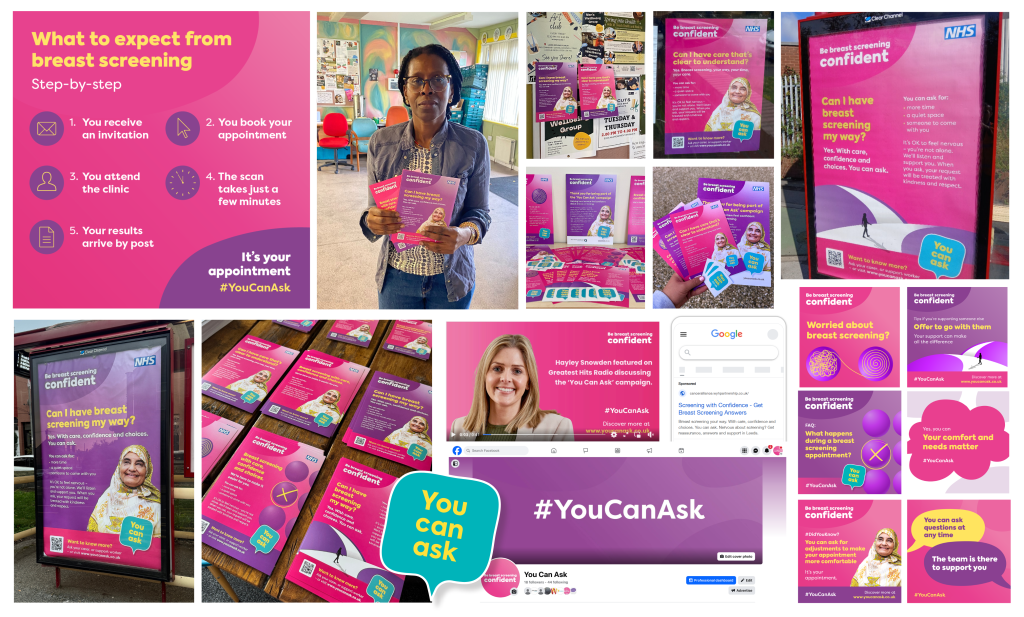
Every asset was built around reassurance, choice and confidence. The language was simple. The visuals were inclusive. The message was repeated consistently across every channel so women, families, carers and staff heard the same thing again and again.
You can ask questions. You can ask for more time. You can ask for support.
Every channel had a job to do.
The audiences we needed to reach included women who may not be active online, women who may not trust advertising, women who may need information in more accessible formats and women who are supported by family members, carers or community groups.
So we built a multi-channel campaign where each touchpoint had a clear role.
Paid social activity across Facebook and Instagram helped build awareness at scale, reaching women aged 50 plus, carers and families in priority areas. The social campaign ran across engagement and traffic strands, using static, motion and carousel formats to introduce the You Can Ask message and drive people to clear, reassuring information.
The creative was not designed to shock or pressure. It was designed to explain. That is why carousel formats worked so well, particularly for women aged 50 plus. They gave us space to show what happens at an appointment, explain that support is available and make the message feel easier to absorb.
Google Search Ads played a different role. They reached people at the moment they were already searching for answers, using terms such as “what happens at a breast screening appointment” and “breast exam what to expect.” The purpose was not to provide medical advice. It was to meet people at a moment of uncertainty and guide them towards reassurance.
Community outreach was critical. We knew a lot of the women most likely to benefit from the campaign wouldn’t be reached through digital channels. So the campaign worked through trusted local organisations, charities, community groups and breast screening units. Easy Read packs, posters, flyers and stickers helped the message travel into familiar spaces where women could engage at their own pace.
Out-of-home advertising placed the campaign in everyday environments, including bus stops near community centres and healthcare settings. Printed materials in invitation letters reinforced the message at the exact moment women were making decisions about whether to attend. Staff engagement helped make sure You Can Ask was not just a public-facing campaign, but something embedded into the service itself.
That is what made the campaign work.
It was not one big message pushed through one channel. It was one clear message reinforced through many trusted routes.
The results were strong because the strategy was strong.
Over three months, the paid social campaign delivered more than 1.8 million impressions.
That is a significant number, but it is not the most important one.
The real value is what those impressions represented: repeated exposure to a reassuring message among women, families and carers who needed to understand that support was available.
Paid social also drove 5,695 website clicks, helping direct people to clearer information at moments of consideration. Traffic ads targeting families, carers and support networks were especially effective, driving 3,059 clicks to the You Can Ask landing page. That matters because it reinforced something we suspected from the outset: carers and family members often play a crucial role in helping women feel confident enough to attend.
Google Search Ads achieved a 7.78% click-through rate. For a highly localised, awareness-led public health campaign operating within healthcare tracking restrictions, that is a strong signal. It shows that when people were actively looking for information about breast screening, the You Can Ask message resonated.
Community outreach became one of the campaign’s strongest proof points. Forty-nine organisations responded to outreach activity, and 37 community groups requested packs. These were not passive impressions. These were trusted organisations choosing to share the campaign with the women and communities they support.
The estimated potential community reach was 114,486 people, with additional requests including six packs and 100 extra leaflets for a women’s event with more than 500 attendees, plus 200 additional leaflets requested by LS14 Trust to include in their community packs.
That is what meaningful reach looks like in healthcare. Not just an ad appearing on a screen. A trusted person, in a trusted place, sharing information that feels relevant.
The patient feedback showed the real impact.
The strongest evidence came from women themselves.
A paper-based patient survey was completed by 250 breast screening patients across Pudsey and Kirkstall. Around 40% of respondents said they were aware of the You Can Ask campaign, and more than a third said the campaign had helped support their screening appointment.
Their comments show exactly why the campaign mattered.
One woman said knowing she could ask for more time helped her relax because she was anxious about the appointment. Another said knowing a longer appointment was available was helpful. Another described feeling empowered by knowing she could ask for reasonable adjustments.
That is the kind of impact healthcare marketing should aim for.
Not just recognition or clicks. A person feeling less anxious, more informed and more able to access care.
The wider outcomes were genuinely meaningful.
Although the primary aim of the campaign was to empower women to ask for reasonable adjustments, the wider screening data showed encouraging changes.
Between the 2022 and 2025 screening rounds in Pudsey, overall breast screening attendance increased by 12.5%. The proportion of women who did not attend reduced by 19.8%. For first mammogram screenings, non-attendance reduced by 30.6%.
No responsible healthcare marketer would claim that a campaign alone caused those changes. Screening attendance is influenced by many factors, including service activity, operational changes, local context and wider patient engagement.
But the data does suggest something important.
When communications reduce uncertainty, build confidence and make support visible, they can become part of meaningful behaviour change.
That is why the results matter. Not because they look impressive in a report, although they do. Because they show what can happen when healthcare marketing focuses on the real barrier, not the assumed one.
The campaign changed more than patient awareness.
One of the most important outcomes was what happened inside the service.
The campaign included awareness training for around 30 staff, with learning shared across the wider Leeds and Wakefield Breast Screening Team, reaching a further 20 people. New staff will be introduced to the campaign as part of induction, and the service now continues to use the You Can Ask message when supporting patients to request reasonable adjustments.
That matters because the best healthcare campaigns do not disappear when the media spend ends. They leave something behind.
In this case, the campaign helped create shared language around reasonable adjustments. It gave staff a simple phrase they could use. It gave patients a message they could remember. It gave community groups something practical to share.
It helped turn an important idea into everyday practice.
What You Can Ask taught us about healthcare marketing
The success of You Can Ask was not built on one clever advert. It came from insight, empathy and a willingness to ask a better question.
Instead of asking, “How do we tell more women to attend breast screening?” we asked, “What is stopping women from feeling able to attend?” That is the difference between awareness-led marketing and behaviour-led marketing.
Awareness says: here is the information. Behaviour-led marketing asks: what does someone need to feel safe enough, confident enough or supported enough to act?
For healthcare organisations, that distinction is everything, because the people who are least likely to engage with services are often not ignoring the message. They may be overwhelmed by it. Unsure about it. Excluded from it. Unable to access it. Or unconvinced that it was designed with them in mind.
The role of good healthcare marketing is not simply to make more noise. It is to make the next step feel possible. You Can Ask did that.
It reached people at scale. It worked through trusted communities. It gave women clear information. It supported carers and families. It helped staff talk about reasonable adjustments. And most importantly, it gave women permission to ask for what they needed.
That is why this campaign matters.
Because sometimes the most powerful thing marketing can do is not persuade someone. It is remove the barrier that was stopping them all along.