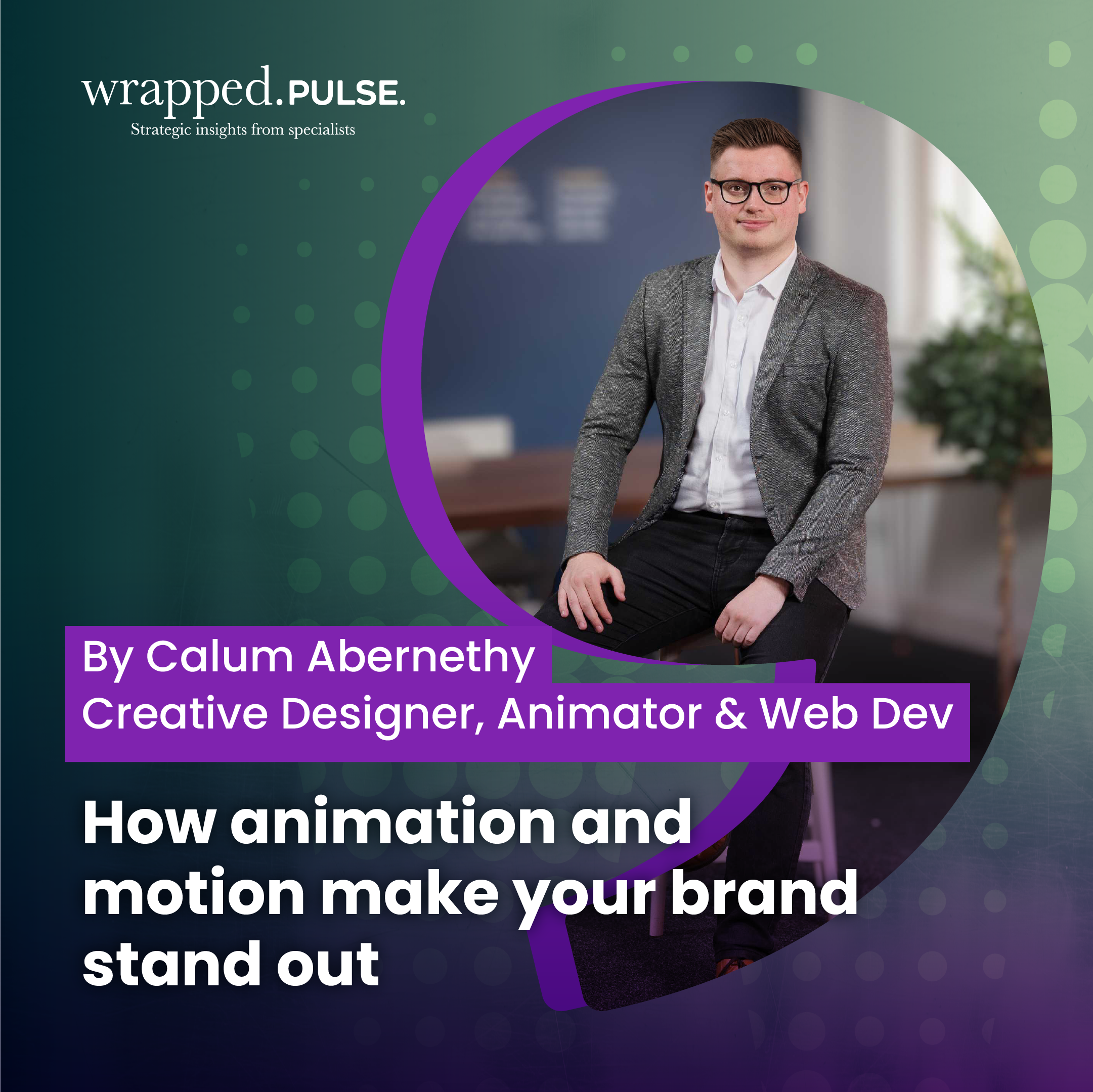

By Calum Abernethy, Creative Designer, Animator & Web Developer at Wrapped Agency
Most brands are creating more content than ever. Social posts, paid ads, email campaigns, pitch decks, launch videos, website assets, event screens, reels, stories, presentations — there is a constant need to say something clearly and make people care quickly.
That is where motion can be really useful.
Animation gives a brand another way to communicate. It can bring energy to a campaign, make a social post more noticeable, explain a service more clearly or help a piece of content feel less static. It does not have to mean a full animated film or a huge production. Sometimes it is a short loop, a simple transition, a moving headline or a few animated elements that help the message land.
The important thing is that the movement has a purpose. Animation should not just be added because it looks impressive. It should help someone notice, understand or remember something.
Motion earns attention quickly
People scroll quickly. That is true on social, in inboxes, on websites and across most digital spaces. You often have a very small window to catch someone’s eye before they move on.
Motion helps because movement naturally stands out. A static post can work, but a moving version can give the same idea more presence. An animated headline, a product reveal, a moving graphic or a short teaser can stop content feeling flat, especially when it is competing against everything else in someone’s feed.
That does not mean everything needs to move. In fact, too much motion can have the opposite effect. If a piece of content is full of unnecessary movement, the message gets lost. The best motion is usually focused. It knows what it wants someone to look at and guides them there.
Animation can make ideas easier to understand
Some messages are hard to explain in one image. A process, a product feature, a service offer or a campaign idea can become too wordy if everything has to be written out.
A short motion graphic can show a process step by step. An animated icon can make a feature feel clearer. A moving diagram can explain something quicker than a paragraph. This is useful across lots of formats, from social posts and sales presentations to explainer videos, digital ads and website content.
Good animation does not need to overcomplicate the idea. It should do the opposite. It should strip the message back, show the important parts and make it easier for people to follow.
This is particularly valuable in healthcare and medtech marketing, where animation can help explain complex services, medical technologies and patient journeys in an accessible way. Financial services and fintech brands can use motion graphics to communicate processes and product features more clearly, while property developers can bring new developments to life through animated visualisations. For charities, animation can make complex issues easier to understand and help communicate the impact of their work. Across these sectors, effective animation combines creativity with a clear understanding of the audience, the message and any relevant regulatory considerations.
Motion gives campaigns more flexibility
One of the biggest benefits of motion is that it gives a campaign more ways to show up. A strong campaign idea might start as a static visual, but motion can help it stretch across different channels.
You can create short social loops, animated story formats, digital ad variations, email headers, event screen graphics, presentation slides, video intros and website assets from the same creative direction. That makes the campaign feel more joined up without every piece needing to be identical.
This is especially useful when a brand needs content in lots of different sizes and formats. A square social post, a vertical reel, a widescreen presentation slide and a website banner all behave differently. Motion gives you more room to adapt the idea while keeping the same overall feel.
Small details can add a lot of personality
Motion does not always need to be big. Some of the most effective animation is subtle.
A logo reveal at the start of a video. A simple type animation on a social post. A button interaction. A transition in a presentation. A small movement in an icon set. A loading screen that feels more considered. These details might not be the main message, but they influence how the brand feels.
The way something moves can say a lot. Fast, sharp motion can feel confident and energetic. Slower movement can feel more refined. Playful motion can make a brand feel warmer. Clean transitions can make content feel more professional and polished.
That is why motion should be treated as part of the brand style, not just an extra effect. When it is consistent, it makes the brand easier to recognise.
It can make content feel less generic
A lot of digital content uses the same templates, layouts and stock-style visuals. That is not always a problem, but it does make it harder for a brand to feel distinctive.
Bespoke motion helps because it can be shaped around the brand. The pace, transitions, typography, illustration style, icon movement and video treatment can all be designed to feel specific. That gives the brand something more ownable than a static post or a generic template.
It also helps content feel more finished. A simple animation can make a launch announcement feel bigger, a presentation feel more polished or a social campaign feel more active. It gives the work another layer without needing to make everything complicated.
Motion still needs restraint
The risk with animation is overdoing it. Just because something can move does not mean it should.
Too much motion can distract from the message, make content feel messy or slow things down. On websites, it can affect performance. In social content, it can make the design harder to read. In presentations, it can become annoying if every slide is trying to do too much.
Accessibility is another important consideration. Website animations should respect users’ reduced-motion preferences, avoid unnecessary flashing and give people control over movement that could distract from content or make a website difficult to use.
The best motion feels intentional. It supports the idea, fits the format and respects the audience’s attention. A three-second social loop needs a different approach from a brand film. A pitch deck transition needs a different level of movement from a campaign video. The format should always guide the animation.
Make the movement mean something
Animation and motion can help a brand stand out, but only when they are doing a job. They should help people notice the right thing, understand the message more quickly or remember the brand after they have seen it.
That is the difference between motion that just looks nice and motion that adds value.
Used well, animation can make content feel sharper, more flexible and more engaging. It can help campaigns travel further, make social posts work harder, improve presentations and bring more character into digital content.
Brands do not need movement everywhere. They need movement in the right places.
Need motion that works harder for your brand?
At Wrapped, we create motion, campaign assets and digital content that help brands communicate with more energy and clarity. From social animations and campaign creative to explainer content, presentation assets and website motion, we help brands use movement with purpose.