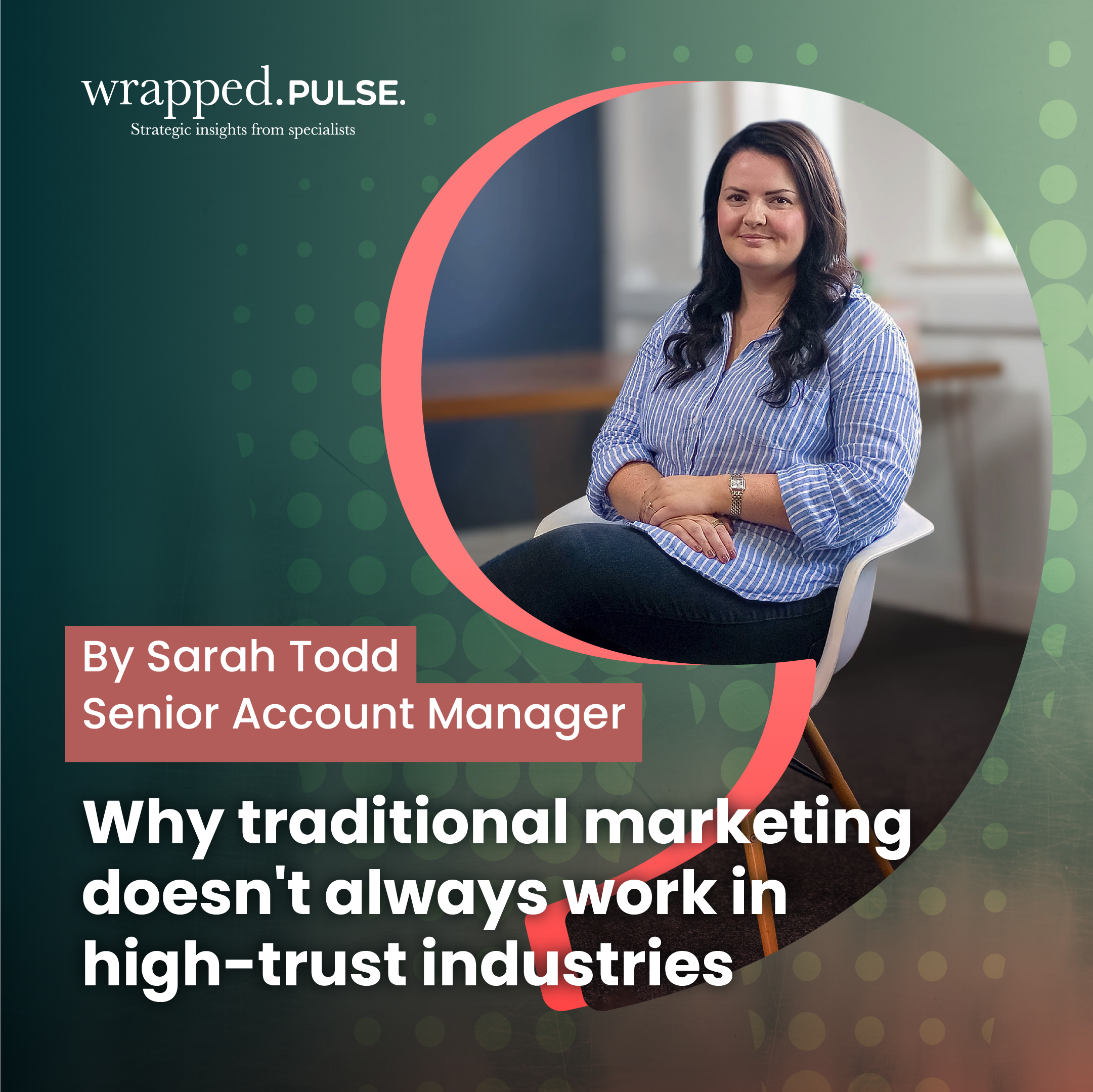

By Sarah Todd, Senior Account Manager at Wrapped Agency
Marketing a healthcare service, financial product or insurance policy isn’t quite the same as marketing an everyday consumer purchase. The fundamentals might be similar, but the decisions people are making, and the consequences of getting those decisions wrong, can be very different.
A compelling campaign might generate attention and enquiries, but in high-trust industries, that’s only part of the job. People often need more information, more reassurance and more time before they’re comfortable taking the next step.
Working with clients in these sectors, I’ve seen how important it is to understand those considerations before developing the marketing approach. The challenge isn’t to make communications less persuasive or creative. It’s to make sure they give people what they actually need to make an informed decision.
Same marketing principles. Different stakes.
In marketing, we’re used to talking about attention, engagement and conversion. They’re important measures of success, whatever the industry.
But in healthcare, financial services, insurance, property and other high-trust sectors, there’s another consideration: the potential consequences of the decisions we’re influencing.
This is where Your Money or Your Life (YMYL) comes in.
Originally introduced through Google’s Search Quality Rater Guidelines, YMYL describes topics that could significantly affect people’s health, financial stability, safety or wellbeing.
YMYL isn’t a marketing regulation, but it’s a useful way of describing the types of subjects where accuracy, trust and the quality of information are particularly important. For marketers working in healthcare, finance, insurance and other high-trust sectors, those considerations extend well beyond search visibility.
There’s a difference between encouraging someone to buy a new pair of trainers and helping them understand their healthcare options or choose a financial product.
Both require good marketing. But the audience’s needs, the information required and the potential consequences are very different.
When familiar marketing tactics fall short
Traditional marketing techniques aren’t necessarily wrong for high-trust industries. They just need to be applied with greater understanding and judgement.
Take urgency, for example.
Creating a sense of urgency can be an effective way to encourage action. But when someone is making an important financial or healthcare decision, pressure isn’t always helpful.
For example, a limited-time offer might be perfectly appropriate for an everyday retail product, but using the same approach to encourage someone to make a decision about a medical treatment or financial commitment needs much more consideration. The objective should be to help people understand their options, not make them feel they have to decide before they’re ready.
Or consider the familiar advice to keep messages short and simple.
Clarity is essential, particularly when explaining complicated products or services. But there’s a difference between making something easier to understand and leaving out information someone needs to make an informed decision.
We’ve all seen websites where the important details are technically available, but finding them takes far more effort than it should. In these sectors, good user experience isn’t just about making a journey quicker. It’s about making sure people can find the information they need, understand it and feel confident about what happens next.
Then there are the claims we make.
A bold promise might grab attention, but in high-trust sectors, that promise needs to stand up to scrutiny. If the evidence doesn’t support it, the potential damage goes well beyond a disappointing campaign.
These aren’t reasons to abandon persuasive marketing. They’re reasons to think more carefully about how we use it.
Compliance and creativity aren’t opposites
There’s a common perception that marketing in regulated or sensitive industries means playing it safe.
More restrictions. More approvals. Less room for ideas.
We see it differently.
Understanding the requirements of a sector doesn’t have to limit creativity. In fact, bringing that knowledge into the process early can help produce stronger, more considered work.
For example, understanding advertising platform policies before developing a campaign can help avoid concepts that won’t be approved. Knowing which claims can be supported allows creative teams to build stronger messages around credible evidence. And involving compliance teams at the planning stage can reduce unnecessary reworking further down the line.
It’s about making informed decisions from the outset, rather than discovering the limitations once the creative work is finished.
From an account management perspective, this is where getting the right people involved early makes a real difference. If a campaign needs clinical, legal or compliance approval, understanding who needs to review it, what evidence is required and which elements are non-negotiable helps everyone plan more effectively.
It also gives the creative team a clearer brief. Rather than developing an idea and hoping it survives the approval process, you can identify the boundaries at the beginning and work creatively within them. That tends to make for a much more productive relationship between the client, the agency and the people responsible for signing everything off.
It also means working collaboratively.
Our clients know their businesses, their customers and their regulatory responsibilities. We bring specialist marketing expertise, audience insight and creative thinking to help turn that knowledge into communications that work.
When those perspectives come together early, compliance becomes part of the creative process rather than a hurdle at the end.
Understanding people, not just audiences
Perhaps the biggest difference in high-trust marketing is the need to understand not just who your audience is, but what they might be experiencing.
Someone researching a medical condition may be anxious or uncertain. Someone comparing financial products may be unfamiliar with the terminology. Someone navigating housing or insurance decisions may be under significant pressure.
These circumstances affect how people interpret information and respond to marketing. And they should influence how we communicate.
That understanding needs to come from more than assumptions about an audience’s age, location or interests. Research, conversations with customer-facing teams, search behaviour and feedback from the people using a service can all reveal questions or concerns that aren’t obvious from a marketing brief. Those insights can change everything from the language used in a campaign to the information included on a landing page.
That might mean making complex information more accessible, reconsidering an overly persuasive message or choosing an approach that gives people greater confidence in their decisions.
It also means thinking carefully about targeting.
Digital platforms give marketers sophisticated ways to reach specific audiences. But just because we can identify and target someone doesn’t always mean we should.
Responsible targeting uses insight to make communication more relevant. It shouldn’t use someone’s circumstances or vulnerabilities to increase pressure.
None of this means compromising on commercial ambition.
Clearer communication, more relevant content and greater audience confidence can all contribute to stronger engagement and more sustainable relationships.
Good marketing and responsible marketing should be working towards the same outcome.
Building the knowledge behind better marketing
One of the challenges for marketers working in high-trust sectors is that specialist knowledge often develops through experience. You learn which claims need additional evidence, how advertising platform restrictions affect campaigns and why certain audiences need a different approach.
But that knowledge shouldn’t have to come entirely from trial and error.
It’s one of the reasons we’ve developed Wrapped Cert, our five-module, CPD-accredited course covering the practical realities of YMYL marketing. It brings together areas such as platform restrictions, ethical targeting, governance and accessibility, helping marketers understand the considerations that can affect their work before they become problems.
For me, the value of that knowledge is in the decisions it helps people make every day. Whether you’re briefing a creative team, reviewing a campaign or planning a new website, understanding the sector you’re working in puts you in a much stronger position to do the job well.
Different stakes call for better thinking
The fundamentals of marketing haven’t changed. We still need to understand audiences, develop good ideas and create communications that encourage people to act.
But in high-trust industries, we need to think carefully about how we achieve those results. The information people need, the circumstances they’re making decisions in and the responsibilities of the organisations communicating with them all have to be considered.
That’s why I think specialist knowledge is so important. It helps marketers ask better questions, brief teams more effectively and recognise potential issues before they affect the work.
And when that understanding is built into the process from the beginning, there’s no reason creativity and commercial performance should suffer. In fact, it gives both a much better chance of succeeding.
Ready to build your expertise in high-trust marketing?
Explore Wrapped Cert, our five-module, CPD-accredited course designed to help marketers navigate the challenges and opportunities of YMYL marketing.