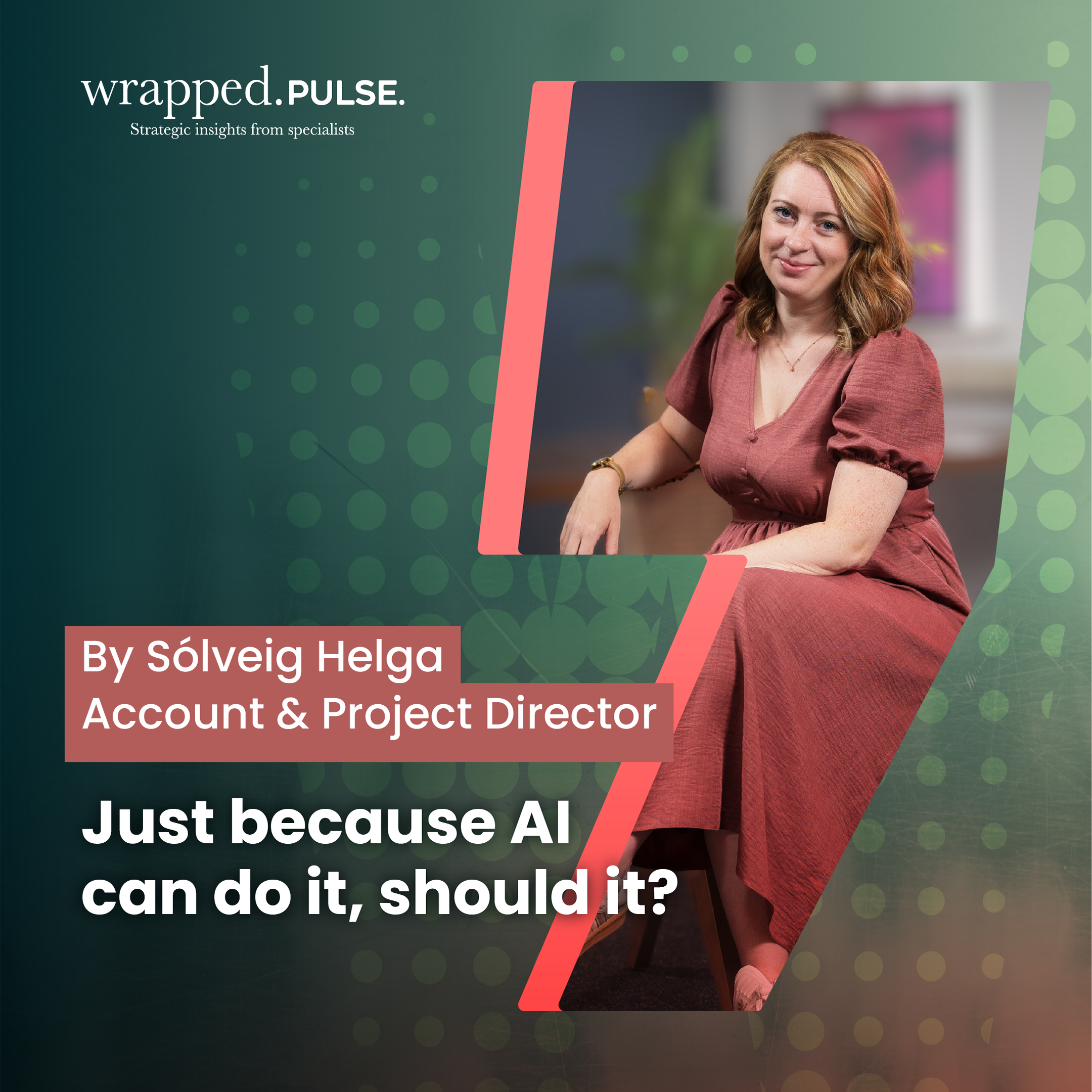

By Solveig Helga Account & Project Director at Wrapped Agency
Why knowing when to use AI is becoming just as important as knowing how to use it.
AI seems to have found its way into just about every conversation in marketing. Whether it’s writing content, creating images, developing campaign ideas or analysing data, there’s usually a tool promising to do it faster, and sometimes at a fraction of the cost.
I can see why that’s appealing. When you’re managing client projects, dealing with deadlines and trying to make budgets work harder, anything that helps is worth looking at. According to HubSpot’s 2026 State of Marketing report, 80% of marketers use AI for content creation and 75% for media production, so it’s clearly becoming a normal part of how marketing teams operate.
But I do wonder whether we’re spending too much time talking about what AI can do and not enough time considering whether it’s the right approach.
If we can generate a campaign image in seconds, does that make it the best image for the campaign? If we can produce twenty versions of a headline in a minute, are any of them necessarily better than something a creative team has spent time developing?
There’s a tendency to assume that faster and cheaper must mean better, when actually the quality of the end result should still be what matters.
And when you’re working in industries where trust, accuracy and authenticity are particularly important, getting that decision wrong can have consequences beyond an underperforming campaign.
There’s plenty to like about AI
I don’t want this to sound like an argument against AI, because I think there are plenty of ways it can make working life easier.
Pulling information together, organising notes, supporting research, preparing reports and adapting existing content are all things that can take up a surprising amount of time, particularly in an agency where you’re managing several projects at once.
A 2026 survey by Basis found that 75% of marketing and advertising professionals had seen moderate to significant efficiency improvements from AI over the previous year. That’s encouraging, especially when marketing teams are being asked to achieve more with the resources they have.
What interests me, though, is what happens to the time we save.
If AI makes the more repetitive parts of our jobs easier, I’d hope that gives us more time to understand our clients, think about their challenges and develop better ideas.
What I wouldn’t want is for efficiency to become the main measure of whether we’re doing a good job, because producing something in twenty minutes instead of two hours is only an improvement if the result is still right.
The brief doesn’t always tell you everything
One thing you learn from working with clients is that there’s often quite a lot going on behind a brief.
There are conversations that have happened before a project starts, things the business has tried in the past, opinions within the organisation and commercial pressures that aren’t necessarily written down. Sometimes there are concerns that only come to light once you start asking questions.
Understanding those things is often what helps you get to the right solution.
AI doesn’t know that background unless someone tells it, and even then, it can only work with the information it’s been given. It might produce a perfectly reasonable campaign concept, but that doesn’t mean it’s right for the client or the audience they’re trying to reach.
This is particularly relevant when working with organisations that have multiple audiences and complex challenges.
A healthcare provider might be communicating with patients, families and healthcare professionals, all of whom need different information. A fintech business might need to build confidence with consumers while communicating a much more technical proposition to commercial partners.
And a charity might be trying to raise awareness, engage potential donors and support vulnerable service users, all within the same campaign.
An idea that works for one audience won’t necessarily work for another, even if it looks good on paper.
I’ve always thought one of the most valuable parts of working with an agency is having people who will question the brief rather than simply deliver what’s been asked for.
Sometimes a client comes to you with a particular idea, but once you’ve talked it through, you realise there’s a different problem that needs solving.
That kind of conversation can change the direction of a project completely, and it’s not something I’d want to lose simply because producing the first idea has become easier.
When the image looks right but tells the wrong story
AI-generated imagery is an interesting example of where the technology can be impressive but still needs careful thought.
The ability to create realistic visuals without organising a photoshoot or commissioning bespoke artwork opens up possibilities, particularly for organisations working with smaller budgets.
But there are situations where the image itself is part of what people are being asked to trust.
Healthcare: Accuracy matters as much as appearance
Healthcare marketing is a good example of where AI-generated imagery could be genuinely useful.
Photographing real patients isn’t always appropriate, particularly when you’re communicating about sensitive conditions or personal experiences. AI can make it easier to create illustrative imagery without needing to involve identifiable patients or navigate the consent and privacy considerations that come with using their photographs.
But there’s another side to that.
If an AI-generated image shows a clinical setting, treatment or patient experience, it still needs to be accurate and appropriate.
An image that looks reassuring but misrepresents what someone can expect could be misleading, particularly when people are using that information to make decisions about their health.
The same applies to medical devices, treatments and pharmaceutical communications, where seemingly small visual inaccuracies could create a misleading impression of how a product works or what outcomes it can achieve.
So while AI might solve one problem around consent, it doesn’t remove the need for careful human judgement about what the image communicates.
Property: Helping people visualise without misleading them
The same applies to property marketing.
AI can help visualise a development before it’s built, and computer-generated imagery has been used in the sector for years.
But there’s a difference between helping someone imagine a finished space and presenting something in a way that could mislead them about what they’re buying.
If a visual shows features, finishes or surroundings that aren’t part of the actual development, the fact that it looks convincing becomes part of the problem.
For buyers making one of the biggest financial commitments of their lives, those details matter.
AI-generated imagery can be an excellent way to bring an idea to life, but it needs to be an accurate representation of what is being offered, with appropriate clarification where imagery is illustrative.
Charities: Authenticity and sensitivity come first
For charity marketing, AI-generated imagery could offer similar benefits when communicating about vulnerable people or difficult personal experiences.
It may be possible to illustrate a situation without asking someone to share their story publicly or appear in campaign photography.
But authenticity matters, particularly when charities are asking people to trust them or support a cause.
There’s a difference between using an illustrative image and creating something that audiences might reasonably believe depicts a real person or event.
For example, if a fundraising campaign uses an AI-generated image that appears to show someone directly affected by the cause, audiences may assume that person and their circumstances are real.
Even if the intention is simply to illustrate an issue, the way that image is presented could undermine trust if its nature isn’t clear.
Charities have a responsibility to communicate sensitively and accurately, particularly when representing people who may be vulnerable or unable to speak for themselves.
AI can support that process, but it shouldn’t replace thoughtful decisions about how people and their experiences are portrayed.
None of this means AI-generated imagery shouldn’t be used.
It means the decision needs to be based on what the communication is trying to achieve and how the audience is likely to interpret it, rather than simply whether the technology can produce something that looks good.
It’s also why questions around transparency, labelling and authenticity are becoming increasingly important, something we’ve explored in our article on AI-generated content and what it means for regulated brands.
Some things still need people who know the client
At Wrapped, we work across sectors where the details matter. Healthcare, financial services, fintech, property and charities all have different audiences, challenges and responsibilities, and what works for one organisation won’t necessarily work for another.
In financial services and fintech, for example, a piece of AI-generated copy might sound clear and persuasive but contain a claim that needs qualifying or doesn’t accurately reflect the product.
It could oversimplify a complex financial service, misrepresent fees or suggest benefits that aren’t supported by the evidence.
In healthcare, language that seems perfectly reasonable to someone unfamiliar with the subject might create confusion or unnecessary concern. It might unintentionally overstate the effectiveness of a treatment or fail to communicate an important distinction.
In charity communications, the same technology might generate an emotionally compelling story but miss the sensitivity needed when discussing real people’s experiences.
These aren’t always obvious problems, particularly when the content reads confidently.
And that’s one of the challenges with AI. Something can appear polished, professional and convincing while still being fundamentally wrong for the intended audience.
There’s also the question of how brands maintain their own personality.
If everyone is using similar tools to generate content, there’s a risk that the work starts to feel increasingly alike.
A brand’s tone of voice isn’t just a collection of adjectives you can put into a prompt. It comes from understanding the organisation, its audience and the way it wants to be perceived.
When you’re working closely with a client, you build up a feel for those things. You learn what they’ll respond to, what doesn’t fit and when an idea needs a different approach.
That knowledge is difficult to capture in a brief, and it’s one of the reasons I think experienced people will remain so important to the creative process.
Of course, there’s a practical responsibility too.
Teams need to think about the accuracy of AI-generated content, confidentiality, intellectual property and whether the material they’re creating is appropriate for the intended use.
In sectors dealing with sensitive personal information, there’s also the important question of what data is being shared with AI tools and whether it should be shared at all.
AI can help with production, but it doesn’t remove the responsibility to check what’s being published, protect confidential information and make sure communications meet the standards expected of the organisation.
Making better use of the time we save
A June 2026 BCG survey found that although 96% of CMOs said AI was driving transformation across their marketing function, only around a third had transformed significant parts of their function using AI agents.
I think that says something about the difference between adopting new technology and genuinely improving how a business works.
For me, the most interesting opportunity isn’t necessarily producing more content or reducing the time spent on every project.
It’s being able to spend more time on the things that make the biggest difference: understanding audiences, developing creative ideas, having better conversations with clients and making informed decisions about where to invest.
In healthcare, that might mean spending more time understanding patient needs and getting complex information right.
In finance and fintech, it could mean focusing more attention on clarity, trust and communicating the real benefits of a product.
For property brands, it might create more opportunities for distinctive creative thinking and a better understanding of what motivates buyers.
And for charities, it could mean spending more time telling meaningful stories, engaging supporters and demonstrating the impact of their work.
Sometimes that might mean using AI to speed up a process.
Other times, it might mean deciding that a particular piece of work needs a photographer, a writer, a designer or someone with specialist knowledge who can bring something different to it.
And sometimes it might mean questioning whether the work needs to be produced at all.
I think that’s an important part of what agencies should offer.
Clients don’t just need people who can produce things quickly. They need people who understand their businesses, are prepared to challenge ideas and can recognise when something isn’t quite right, even if it looks good on paper.
AI will undoubtedly continue to change how we work, and I think there’s plenty to be excited about.
But as the technology becomes more capable, I hope we become more thoughtful about where we use it, rather than feeling we need to use it for everything.
Just because AI can do something doesn’t mean it’s always the best way to do it.