
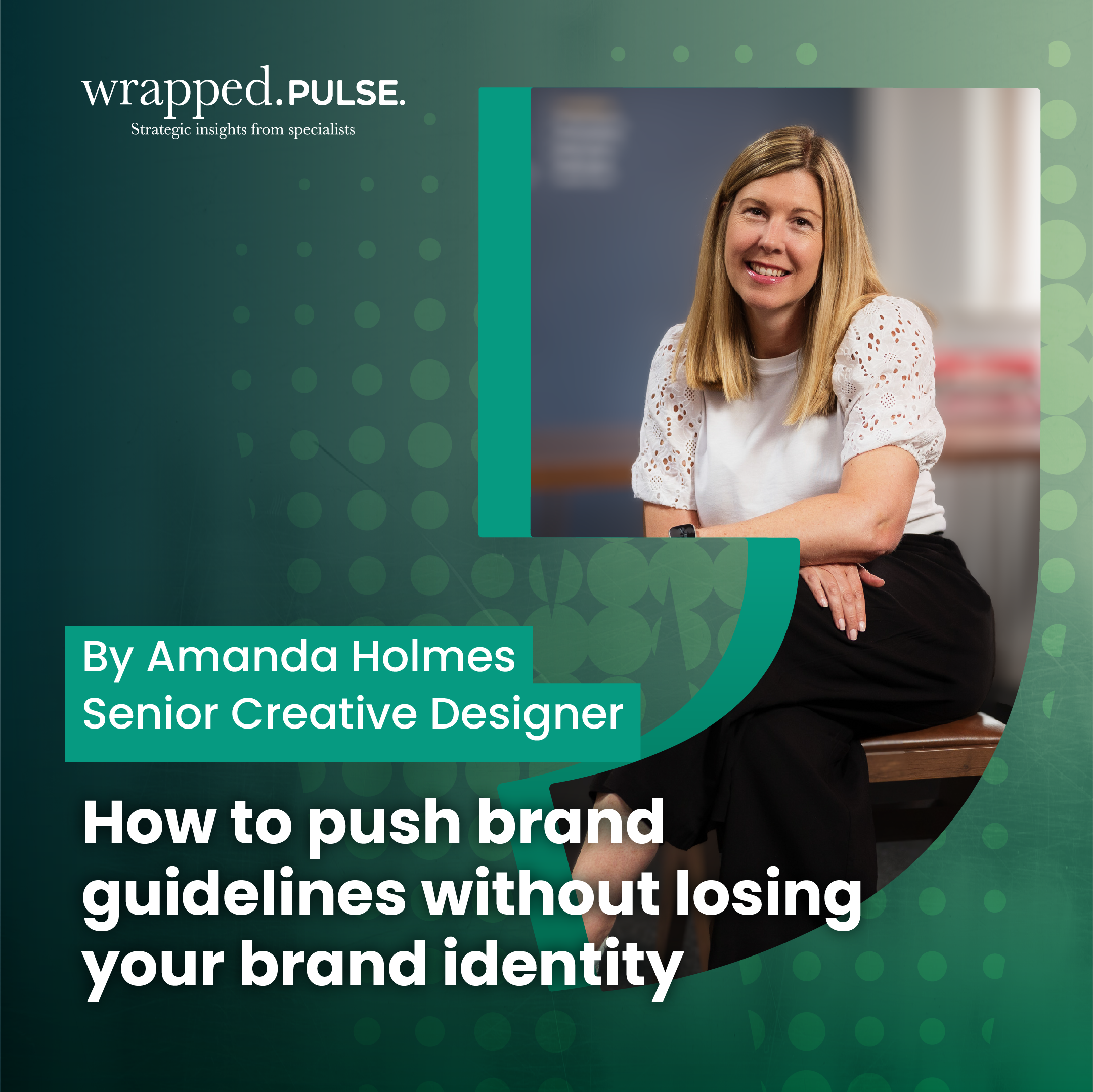

By Amanda Holmes, Senior Creative Designer at Wrapped Agency
How to keep established brands looking fresh, without losing what makes them recognisable.
As a designer, there’s something exciting about creating a brand from scratch. You get to explore ideas, develop a visual identity and build something new without having to work around years of existing design decisions.
But some of the most interesting creative challenges come when a client already has an established brand, a set of guidelines and a request to make something feel different.
They want something fresh, but it still needs to look and feel like them.
That’s where the real creative thinking starts.
It’s easy to assume that working within existing brand guidelines is simply a case of following instructions, applying the right colours and fonts, and making sure the logo is in the correct place. But good brand design involves much more than artworking.
The challenge is finding new ways to express a brand without losing the identity people already recognise.
Brand guidelines should give you room to be creative
Brand guidelines exist for a good reason. They help businesses present themselves consistently, whether that’s through a website, a social media campaign, a brochure or a piece of advertising.
Without that consistency, even a strong brand can start to feel disjointed.
But there’s a difference between protecting a brand and making every piece of marketing look exactly the same.
If designers follow guidelines too rigidly, the work can become repetitive. Campaigns start to blend into one another, and opportunities to create something interesting get missed.
I think the best way to approach brand guidelines is to see them as a starting point rather than a set of restrictions.
They establish what makes a brand recognisable, but there’s often plenty of room to explore how those elements can be used.
Know which parts of the brand need to stay consistent
Before you start experimenting, you need to understand the brand properly.
That means looking beyond the logo and colour palette to understand its personality, positioning and the way it communicates with its audience.
Some elements will be essential to maintaining recognition. These might include the logo, core typography, primary colours or particular graphic devices.
Other elements may offer more flexibility.
For example, a brand might have a very recognisable colour palette but relatively open guidelines around photography, illustration or layout. That gives a designer opportunities to introduce something new without changing the foundations of the identity.
This is where understanding the brand strategy and audience research becomes important. If you know what the brand stands for, who it’s trying to reach and what makes it different, it’s much easier to judge which creative changes will strengthen the identity and which might dilute it.
And if the guidelines aren’t clear, it’s worth having that conversation with the client before starting the design work.
Finding fresh ways to use familiar brand elements
One of the things I enjoy about working with established brands is exploring how existing elements can be used differently.
Sometimes a small change in composition can make a big difference. Using typography at a larger scale, introducing more interesting image crops or changing the balance between photography and graphic elements can give familiar branding a completely different feel.
You don’t necessarily need new colours, new fonts or a redesigned logo. Often, it’s about being more creative with what you’ve already got.
In property marketing, for example, a developer might have an established corporate identity that needs to work across several developments. Each development has its own character, audience and selling points, but the overall brand still needs to feel consistent.
Through our work with Mulberry Homes, I’ve been involved in creating marketing materials that need to balance those requirements. From development brochures and sales collateral to digital creative, the challenge is to give individual pieces of work their own impact while maintaining a recognisable identity across the wider brand.
It’s a good example of why consistency doesn’t have to mean repetition.
Different sectors bring different creative challenges
Working with established brands also means understanding the industry they operate in.
In healthcare and pharmaceuticals, design needs to make information clear, accessible and engaging, sometimes when the subject matter is sensitive or complicated. There’s an opportunity to be creative with imagery, typography and layout, but never at the expense of understanding or trust.
For financial services and fintech brands, visual consistency can help build confidence, particularly when a business is communicating unfamiliar products or entering a competitive market. The creative challenge is to make complex information approachable while maintaining a professional, credible identity.
In property, design often needs to work across corporate branding, individual developments, brochures, advertising and digital campaigns. Each application has a different purpose, but they still need to feel connected.
And for charities, brand recognition can be especially important when communicating different campaigns, causes and fundraising initiatives. There’s room to develop distinctive campaign creative, provided supporters can still recognise the organisation behind it.
The same thinking applies to emerging markets, where brands may be introducing entirely new concepts to audiences. Strong creative design can help make those ideas easier to understand, but it needs to be grounded in what the audience already knows and expects.
For designers, the important lesson is that pushing brand guidelines isn’t simply about making something look different. It’s about understanding what the brand needs to communicate in that particular context.
Designing for different channels and international audiences
Another important consideration is where the design will be seen.
A brand might need to work across everything from a large outdoor advertisement to a small social media graphic.
What works beautifully in a printed brochure won’t necessarily have the same impact on a mobile screen.
When developing creative for websites and digital campaigns, designers also need to consider user experience, accessibility and how people interact with the content. A layout that works in print may need to be adapted considerably for digital use without losing the brand’s identity.
International marketing adds another layer. A brand operating across the UK, Europe and other global markets may need to adapt its imagery, language, typography or messaging to suit different audiences.
Some languages take up more space than others, while cultural expectations around imagery, colour and communication can vary. The design needs enough flexibility to accommodate those differences without becoming inconsistent.
That’s why brand guidelines should help creative teams make informed decisions across different markets and channels, rather than insisting on identical execution everywhere.
When should you challenge the guidelines?
Sometimes the best creative solution involves questioning whether an existing guideline is still doing its job.
Brands evolve. Audiences change. New marketing channels emerge, and design approaches that worked several years ago may not be as effective today.
That doesn’t mean every new campaign needs to reinvent the brand.
But if the guidelines consistently make it difficult to communicate clearly or create engaging work, it’s worth reviewing them.
I’d always start by exploring what can be achieved within the existing identity. If there’s a good reason to introduce a new treatment, colour or graphic element, explain why it would benefit the brand and show how it could work consistently across different applications.
It’s also worth testing new approaches on a smaller scale before introducing them more widely.
That way, changes are considered rather than simply being made because someone wants something different.
Keeping a brand recognisable without standing still
For me, working within established brand guidelines is one of the more interesting parts of being a designer.
Creating something from scratch gives you freedom, but working with an existing identity challenges you to think harder about how to make familiar elements feel fresh.
And that’s where experience and creative judgement really come into play.
The aim isn’t to push boundaries just for the sake of doing something different. It’s to find ways of keeping a brand relevant, engaging and recognisable as its marketing evolves.
Brand guidelines should be the building blocks that support creativity, not the rules that stifle it.