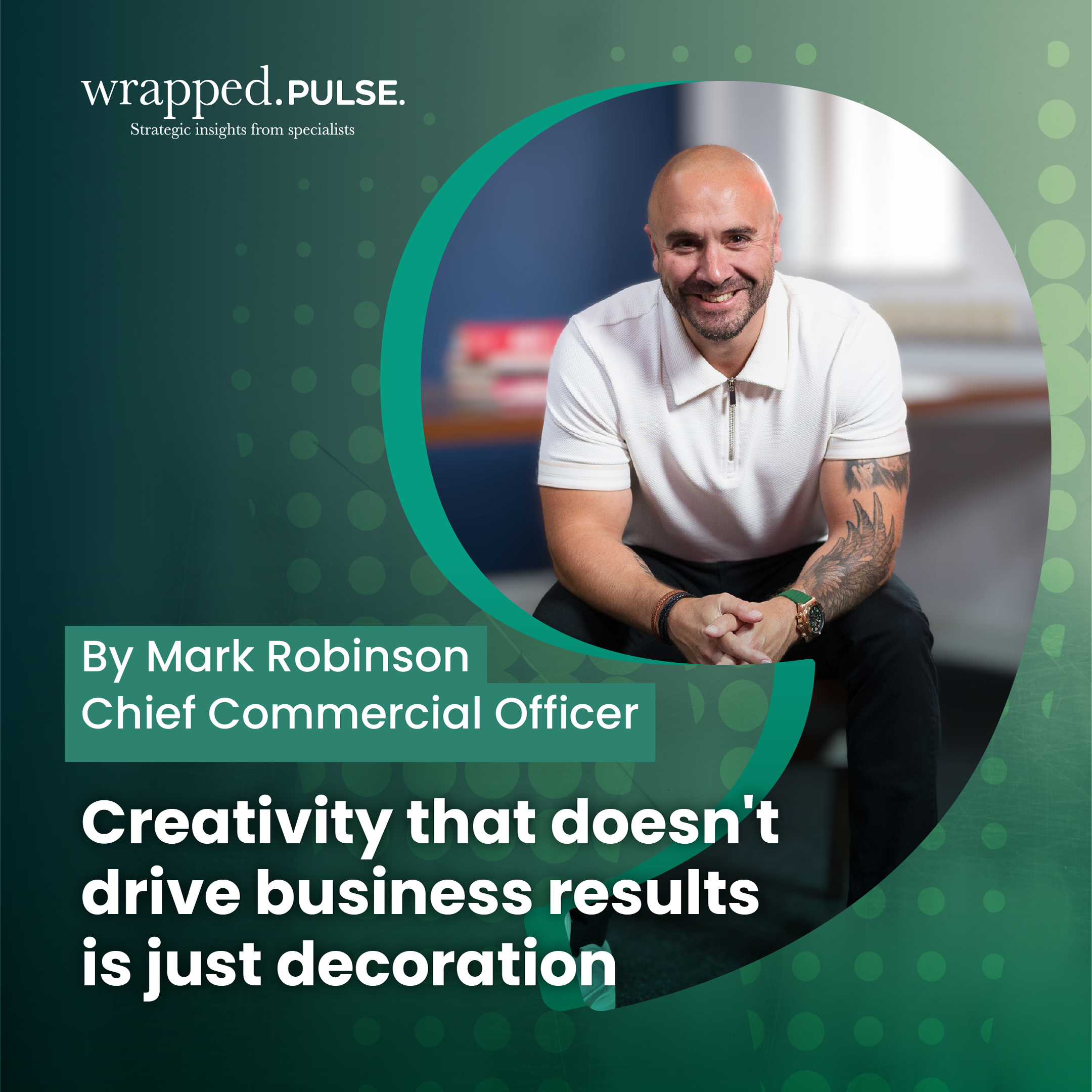

By Mark Robinson, Chief Commercial Officer at Wrapped Agency
Why bold ideas and commercial thinking should never be treated as competing priorities.
I love great creative work. The kind that makes you stop scrolling, think differently or see a brand in a completely new light. The kind that challenges expectations and creates a genuine emotional response.
But having spent more than 25 years working across financial services, fintech and commercial strategy, I’ve learned to ask one important question.
What is that creativity actually achieving?
Because while beautiful design and clever campaigns have their place, creativity needs a purpose. And for the businesses and organisations investing in it, that purpose usually connects to a commercial or organisational objective.
Awareness. Engagement. Enquiries. Sales. Donations. Loyalty. Growth.
If the work isn’t helping move something forward, we need to question whether it’s doing its job.
Creativity and commercial performance aren’t opposites
There’s sometimes a perception that commercial thinking restricts creativity. That focusing too heavily on business objectives somehow makes the work less exciting or less original.
I see it differently.
Having spent much of my career on the client side, I’ve experienced what it’s like to manage multiple agencies, balance competing priorities and justify marketing investment to people who aren’t particularly interested in how beautiful a campaign looks. They want to know what it’s achieved, and that’s a perfectly reasonable question.
A clear commercial challenge can make the creative process more focused and more ambitious. When you understand exactly what needs to change, you have a stronger foundation for developing ideas that matter.
The challenge isn’t simply to create something that looks impressive. It’s to create something that makes a difference.
And that requires both creative ambition and strategic discipline.
What success looks like depends on the sector
At Wrapped, our experience across healthcare, financial services, fintech, property and charities highlights why creative effectiveness can’t be measured in exactly the same way for every organisation.
In healthcare, success might mean helping more people understand an available service, encouraging screening attendance or making complex information easier to navigate. The challenge isn’t always awareness. Sometimes it’s overcoming fear, confusion or mistrust. Creativity needs to be sensitive to those barriers while remaining engaging and accessible.
In financial services and fintech, success could involve building confidence, generating qualified leads or helping customers understand an unfamiliar proposition. I’ve seen throughout my career how difficult it can be to communicate complex financial products clearly, particularly when regulation limits what you can say and how you can say it. That’s where good creative thinking becomes even more important.
In property, creative effectiveness might be measured through stronger market interest, better-quality enquiries or increased engagement with a development. Buying a home isn’t an impulse purchase, so the brand and marketing need to build confidence throughout a much longer decision-making process.
And in the charity sector, success may mean increasing awareness of a cause, inspiring donations, attracting volunteers or changing behaviour. The outcome isn’t necessarily commercial in the traditional sense, but it still needs to deliver meaningful value.
The objectives vary, but the principle is consistent. Creative work should be designed with a clear understanding of what success looks like, rather than deciding how to measure it once the campaign has finished.
Three questions I’d encourage every marketer to ask
You don’t need to turn every creative meeting into a discussion about spreadsheets and conversion rates. Nobody wants that. But there are three questions I think every marketer should be asking before signing off a campaign, brand project or website.
What problem are we actually trying to solve?
“We need a new website” isn’t a business problem. “We’re getting plenty of traffic but not enough qualified enquiries” is.
The same applies to campaigns. Before developing creative concepts, establish what needs to change and why. Is the problem awareness, understanding, trust or conversion?
This is where audience research and brand strategy become valuable. If you don’t understand what people think about your business, what motivates them or what’s stopping them from taking action, you’re effectively asking the creative team to solve a problem you haven’t properly defined.
Is the idea right for the audience?
I’ve sat in enough marketing meetings to know how easily personal preference can take over. Someone likes the colour. Someone doesn’t like the headline. Someone thinks the logo should be bigger.
But what does the audience think?
The best creative ideas aren’t necessarily the ones everyone around the boardroom table likes. They’re the ones that connect with the people you’re trying to reach.
That means understanding their needs, testing assumptions where possible and thinking beyond the initial advert or design. If someone responds to a campaign but lands on a confusing website, you’ve lost the opportunity before they’ve had a chance to engage.
How will we know whether it’s worked?
This conversation needs to happen before launch, not when someone asks for the results three months later.
If the objective is lead generation, impressions alone won’t tell you enough. If you’re trying to build long-term brand awareness, judging everything on immediate sales isn’t particularly helpful either.
Agree the measures that matter, whether that’s brand recognition, engagement, qualified enquiries, conversion rates or changes in audience behaviour. Then use what you learn to improve the work.
Creative effectiveness across international markets
The relationship between creativity and commercial performance becomes even more interesting when you’re working across different countries.
A campaign that works brilliantly in the UK won’t necessarily have the same impact in Germany or another international market. Audience expectations, buying behaviour, cultural influences and competitive pressures can be very different.
In regulated sectors such as financial services, fintech and healthcare, there are additional considerations around local advertising requirements and how products can be communicated.
Simply translating a successful campaign isn’t enough. You need to understand the market you’re entering and what matters to the people you’re trying to reach.
Our work with King Card in Germany is a useful example. By combining market research, creative development and targeted digital advertising, the wider campaign increased the app install conversion rate by 44%, while reducing the average cost per result by 12%.
Those results weren’t achieved by creativity in isolation. They came from understanding the audience, developing relevant messaging and continually refining campaign performance.
For marketers working internationally, that’s an important distinction. A strong creative idea needs to be supported by local insight and a clear commercial objective.
Not everything valuable can be measured immediately
That doesn’t mean every creative idea needs to generate an instant sale.
Brand building often creates value over time. Awareness, familiarity, trust and emotional connection can all influence future decisions, even when their impact isn’t immediately visible in a sales report.
This is particularly relevant in sectors such as healthcare, financial services and property, where decisions can take time and involve considerable thought.
And not every worthwhile outcome can be reduced to a single number.
But that shouldn’t stop us from asking better questions about effectiveness. What behaviour are we trying to influence? Who are we trying to reach? How will we know whether the work has made a difference?
Those questions should be part of the conversation from the beginning, not something we consider after the work has launched.
We should be ambitious about both
For me, one of the most important things an agency can offer is the ability to connect creative possibilities with business realities.
A campaign isn’t just a campaign. It’s an opportunity to change perceptions or encourage action. A brand identity isn’t just a visual system. It’s an opportunity to establish a stronger position in the market. And a website isn’t simply a digital presence. It’s an opportunity to improve communication, engagement and conversion.
Having worked on both sides of the agency relationship, I know how much stronger marketing can be when research, strategy, creative and digital teams understand the same commercial objectives.
I don’t think agencies should have to choose between producing exceptional creative work and delivering meaningful business results. The ambition should be to achieve both.
To create work that’s distinctive, relevant and memorable, while remaining focused on the objectives that matter to the client.
Great creativity gets attention. Commercially effective creativity gives that attention somewhere meaningful to go.
And that’s the kind of work I believe we should all be striving to deliver.