


How better communication reveals what makes you different
Many businesses spend years building something genuinely valuable.
- Better service
- Better systems
- Better people
- Better outcomes
- Better expertise
What is differentiation?
Differentiation is not a slogan.
It’s the specific reason someone should choose you instead of a competitor. That might be:
- Faster delivery
- Better client support
- Specialist expertise
- Stronger governance
- Better outcomes
- Easier onboarding
- Proven sector knowledge
- More flexible service
- Better customer experience
The challenge is not having these strengths. It’s communicating them clearly enough for buyers to notice.
Why strong businesses often sound generic
Many organisations fall into the same traps.
1. They use safe language
Generic phrases feel comfortable internally. But they create no real distinction externally.
If every competitor says they are “trusted” or “innovative,” those words stop meaning anything.
2. They describe services, not value
Buyers care less about what you do than what it helps them achieve.
For example:
❌ We provide multi-channel strategic communications support.
✅ We help regulated brands explain complex offers clearly and win trust faster.
One describes activity. The other communicates value.
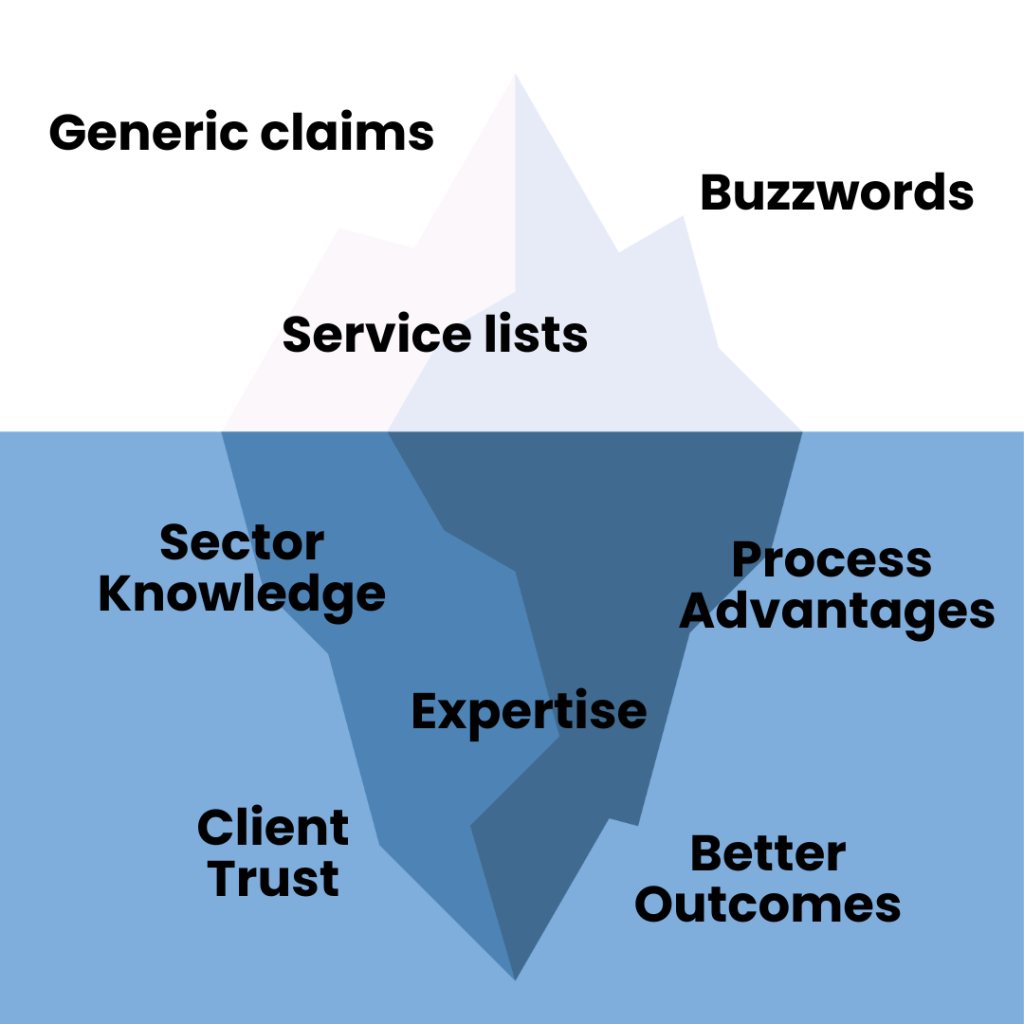
3. Their best differentiators are hidden internally
Often, the strongest selling points sit inside the business:
- A smarter process
- A founder’s expertise
- Better response times
- Sector experience
- Stronger retention
- Better client relationships
Because these strengths feel normal internally, they are often overlooked in marketing.
Why this matters commercially
Poor communication doesn’t just create bland copy. It can slow growth.
Research from Edelman and LinkedIn found that thought leadership and credible expertise can directly influence buying decisions and help businesses earn trust with wider buying groups.
(1)Forrester’s Buyer Insights research shows modern B2B buying decisions are shaped by how buyers research, compare and evaluate suppliers before speaking to sales. That makes clear communication earlier in the journey more important than ever.2
In other words:
Clear, expert communication can create commercial advantage. And confusing, generic messaging can do the opposite.
Real-world examples from regulated sectors
We’ve seen this repeatedly across complex markets.
In fintech
Some platforms have genuinely flexible, high-value propositions. But their websites are filled with product jargon, technical language, and feature lists.
The real advantage – speed, confidence, scalability, commercial support – gets lost.
In healthcare
Organisations delivering exceptional care often lead with broad promises about quality.
What families or commissioners really need to understand is:
- What makes your model different?
- What outcomes do you improve?
- Why should they trust you?
In specialist B2B services
Businesses with excellent operational capability often sound corporate, vague, and interchangeable. The expertise is real. The messaging hides it.
How to communicate what makes you different
Here’s a simple framework.
1. Ask better questions internally
Speak to leadership, sales teams, delivery teams and clients. Ask:
- Why do customers choose us?
- Why do they stay?
- What do we do better than others?
- What do clients thank us for?
- What would be difficult to copy?
The answers are often stronger than the current homepage copy.
2. Replace vague claims with proof
Instead of:
- Trusted partner
- Market leader
- Innovative solutions
Use:
- 98% client retention
- Specialists in regulated sectors
- Average onboarding time cut by 40%
- Trusted by X leading organisations
Specifics build belief.
3. Focus on customer outcomes
Translate internal strengths into external value. Instead of saying:
“We have robust governance processes.”
Say: “You get confidence, compliance and fewer surprises.”
4. Make it consistent everywhere
Your differentiator should show up across:
- Website
- Sales decks
- Proposals
- PR
- Email marketing
- Conversations
Consistency builds memory.
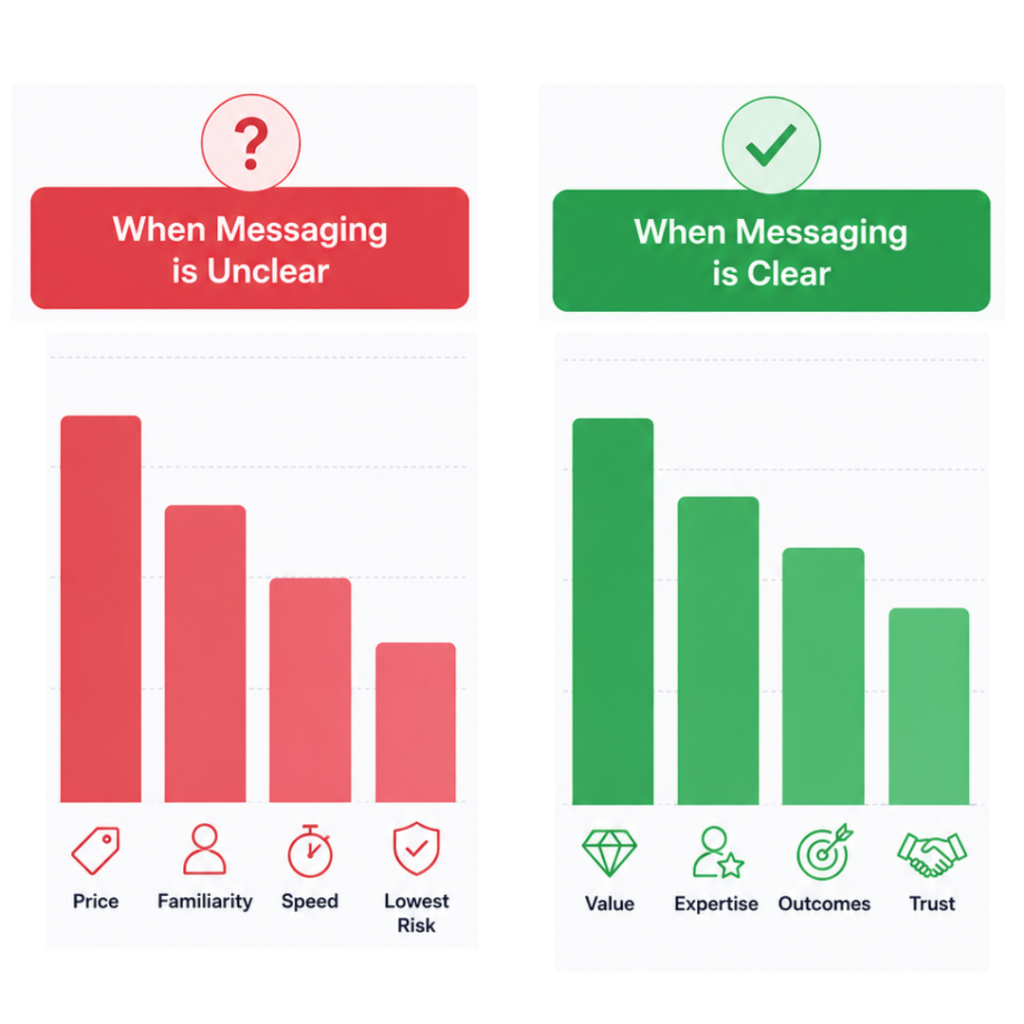
Data insight: buyers reward clarity
Search remains one of the most important ways buyers research suppliers, and digital marketing platform Semrush reports that organic search continues to be a major revenue-driving channel for B2B brands.(3)
That means when buyers find you, your messaging has to work fast.
If they land on your website and still can’t understand why you matter, traffic alone won’t solve the problem.
A useful test for your business.
Look at your homepage. Now remove your logo. Could that copy belong to three competitors?
If the answer is yes, your communication may be hiding your value.
You may not need a new proposition. You may need a clearer one.
What this means for your business
Many businesses already have what they need to stand out. They just haven’t translated it into language the market understands.
When better communication reveals what makes you different, growth becomes easier.
If your business sounds too similar to competitors, the answer may not be a rebrand or a new campaign. It may be sharper messaging.
At Wrapped Agency, we help ambitious brands uncover what makes them valuable – and communicate it in ways buyers actually remember.