
Awareness is important in healthcare marketing. But awareness alone rarely changes anything.
Someone can recognise a symptom without knowing whether it’s something they should be concerned about. They can know they should speak to their GP without knowing what to say when they get there. And they can spend months managing symptoms themselves without getting any closer to understanding what might be causing them.
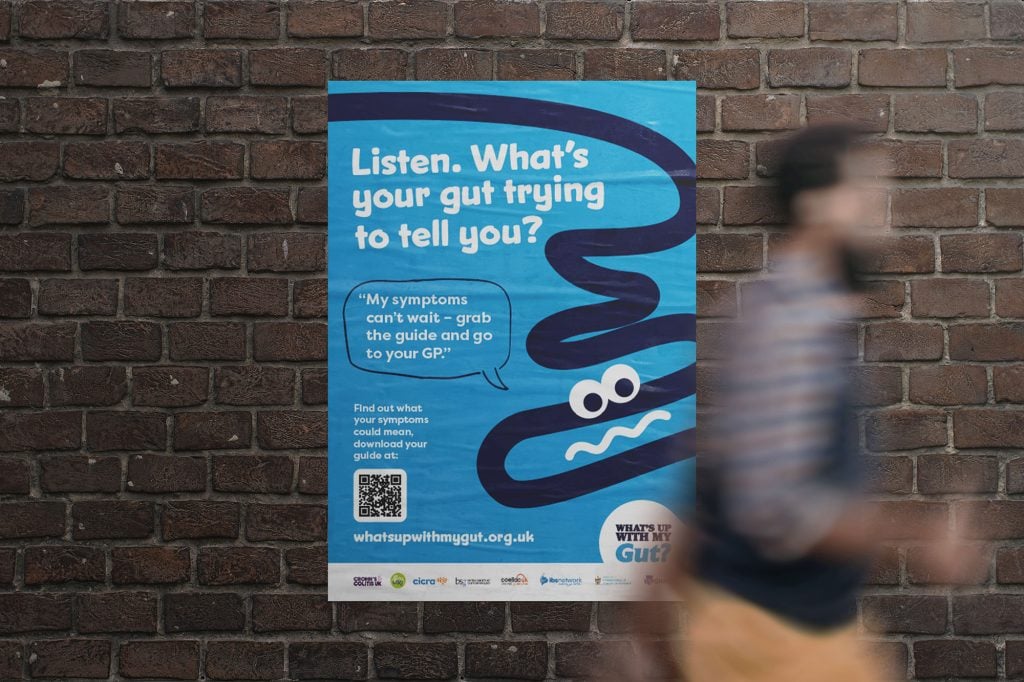
That was the challenge behind What’s Up With My Gut?, a campaign we created with Crohn’s & Colitis UK.
The objective wasn’t simply to get more people talking about gut health. It was to help people experiencing ongoing gut symptoms move from recognising that something might not be right to feeling equipped to do something about it.
Six months after launch, the campaign has generated 66,789 visits to the campaign website and 5,495 downloads of its adult and child resources.
But those numbers become much more meaningful when you understand what the campaign was designed to achieve.
The challenge: symptoms are easy to normalise
Gut symptoms can be difficult to talk about.
They can also be incredibly easy to explain away.
A change in bowel habits might be put down to diet. Abdominal pain might be blamed on stress. Symptoms can come and go, making it tempting to wait and see whether they improve on their own.
For parents, there’s another layer of complexity: understanding when changes in a child’s health or behaviour could warrant further investigation.
The marketing challenge, therefore, wasn’t simply telling people that Crohn’s and Colitis exist.
We needed to reach adults and parents experiencing relevant symptoms, help them recognise when those symptoms might warrant further investigation and make the next step feel clearer.
Because telling someone to “speak to your GP” only gets you so far.
From raising awareness to helping people take action
We built What’s Up With My Gut? around a simple principle: healthcare information is most useful when people can actually do something with it.
The campaign needed to meet people at different stages.
Some might only just be questioning whether their symptoms are normal. Others might already be considering making a GP appointment. Some may have spoken to a healthcare professional before but still be looking for answers.
That meant the campaign journey needed to do more than generate a click.
We created a standalone What’s Up With My Gut? website as a dedicated destination where adults, parents and carers could find clear information about symptoms, understand more about the journey towards diagnosis and feel better prepared for what might happen next.
Importantly, we also created downloadable adult and child resources designed to support more effective conversations with a GP.
They help people think about the information they may need to share, the questions they might want to ask and what they could expect as they move through the diagnosis process.
The marketing therefore had a clear role at every stage:
Get the right person’s attention. Help them recognise the relevance. Give them somewhere useful to go. Help them take the next step.
Building a campaign around the patient journey
To reach people experiencing relevant symptoms, we developed a multi-channel campaign spanning paid social, search, programmatic activity and other digital touchpoints.
But the important part wasn’t simply being present across multiple channels.
It was understanding the role each channel could play in the wider journey.
Someone actively searching for information about ongoing gut symptoms is in a very different mindset from someone who encounters a message while scrolling through social media.
The creative, messaging and calls to action needed to reflect that.
Across the campaign, the focus remained on making the subject approachable and understandable without losing the seriousness of the message.
That balance matters in healthcare.
Create too much fear and you risk alarming people unnecessarily. Make the message too light and you risk giving people another reason to dismiss symptoms they are already ignoring.
Effective healthcare marketing has to find the space between the two.
66,789 website visits. But what happened next?
Within its first six months, What’s Up With My Gut? generated 66,789 visits to the dedicated campaign website.
That tells us the campaign successfully brought a significant audience into an environment where they could learn more.
But traffic was never the end goal.
What happened once people arrived mattered more.
Across the same six-month period, 5,495 adult and child resources were downloaded.
Those downloads represent a much deeper level of engagement than seeing an advert or visiting a webpage.
Thousands of people actively chose to access information created to help them better understand their symptoms, prepare for a conversation with their GP and navigate what could happen next.
We can’t claim that every download resulted in a GP appointment. We can’t say how many people subsequently received a diagnosis. And we shouldn’t. But we can see thousands of instances where someone moved beyond simply seeing a healthcare message and actively sought out a practical tool designed to help them take the next step.
That distinction matters.
What does healthcare marketing impact actually look like?
Marketing performance is often reduced to familiar metrics.
Impressions. Clicks. Traffic. Engagement.
They all have a role in understanding whether a campaign is working.
But in healthcare, the more interesting question is often what did the marketing help someone do?
- Did it help someone recognise a symptom they had been dismissing?
- Did it make complicated information easier to understand?
- Did it give someone the confidence to ask a better question?
- Did it make the next step in their healthcare journey feel clearer?
Those outcomes are harder to fit neatly into a dashboard, but they are exactly why the journey beyond the click matters so much.
For What’s Up With My Gut?, creating downloadable resources meant the campaign could provide something genuinely useful after it had captured someone’s attention.
The advertising created the opportunity to reach people. The website gave them somewhere to explore. The resources gave them something practical to take forward. Together, those elements created a journey from awareness towards action.
Why specialist healthcare marketing matters
Campaigns like this also demonstrate why healthcare marketing can’t simply be approached in the same way as marketing in any other category.
The fundamental marketing principles haven’t changed.
You still need to understand your audience. Capture attention. Communicate clearly. Create a compelling journey. Give people a reason to act.
But the execution carries a different responsibility.
When someone is making decisions about their health or their child’s health, clarity and accuracy matter. The language matters. The emotional impact of the creative matters. The information you provide matters.
And the action you’re encouraging needs to be appropriate.
That’s why our approach combines marketing expertise with an understanding of the healthcare environment we’re communicating within.
The aim isn’t to make healthcare marketing safer by making it less interesting.
It’s to create work that gets attention and deserves the trust that comes with it.
Marketing that moves people forward
The first six months of What’s Up With My Gut? have given us plenty of numbers to measure. But the numbers we’re proudest of are the ones that demonstrate people doing something.
- 66,789 visits to the campaign website.
- 5,495 adult and child resources downloaded.
Behind those figures are people looking for answers about their own health or the health of their child.
And while marketing can’t provide the diagnosis, it can help make the journey towards getting answers clearer.
That’s what this campaign was built to do, and it’s what effective healthcare marketing should aim for.
Not just getting seen. Helping people take a meaningful next step.