
By Martin Jackson Senior Search Specialist at Wrapped Agency
Healthcare is one of those sectors where the obvious version of the campaign is often not the version you can actually run.
The restrictions do not just affect the ad copy. They can affect the campaign type, the targeting, the keywords, the landing page, the creative, and even whether it is worth building the campaign at all. In the UK especially, there are some very clear limits around what can be advertised to the public, how health-related services can be described, and how far you can go with targeting.
From experience, this is usually where the real challenge sits. It is not just a case of asking whether Google will approve an ad. It is also whether you can build a campaign around the topic in a way that is compliant, clear enough to perform, and worth the effort commercially.
TL;DR
- Healthcare businesses can advertise on Google Ads, but the category is tightly restricted.
- In the UK, there are clear limits around promoting prescription-only medicines to the public, but the restrictions go wider than that. Sensitive conditions, diseases, services and treatments can also be difficult or impossible to target directly.
- Search is usually the safest place to start because it lets you appear when people are actively searching. In simple terms, they can come to you, but you usually cannot go out and target them in the same way you might in other sectors.
- There are no predefined Google audiences for people with specific health conditions, and you cannot create your own either.
- Some keywords are workable, some are not, and the line is not always obvious until you test them in-platform.
- Even if a keyword is eligible, that does not always mean you can safely use the same wording in the ad copy or on the landing page.
- It is usually worth testing keyword viability early, before spending too much time building landing pages, assets, ad copy or campaign structure.
Can healthcare businesses advertise on Google Ads?
Yes, in many cases they can.
Healthcare advertising is not banned on Google Ads, but it is more tightly controlled than most sectors. The platform looks at the ad, the landing page, the targeting setup, the location, and in some cases the type of business and the certifications behind it. In the UK, that platform layer then sits alongside CAP guidance, MHRA guidance, and other sector-specific rules.
That is why healthcare campaigns need a slightly different planning process. It is not enough to ask whether the product or service is legal in general. You also need to think about how publicly you can talk about it, how sensitive the topic is, whether the keyword itself is viable, and whether the page you are sending people to says more than the ad is allowed to say.
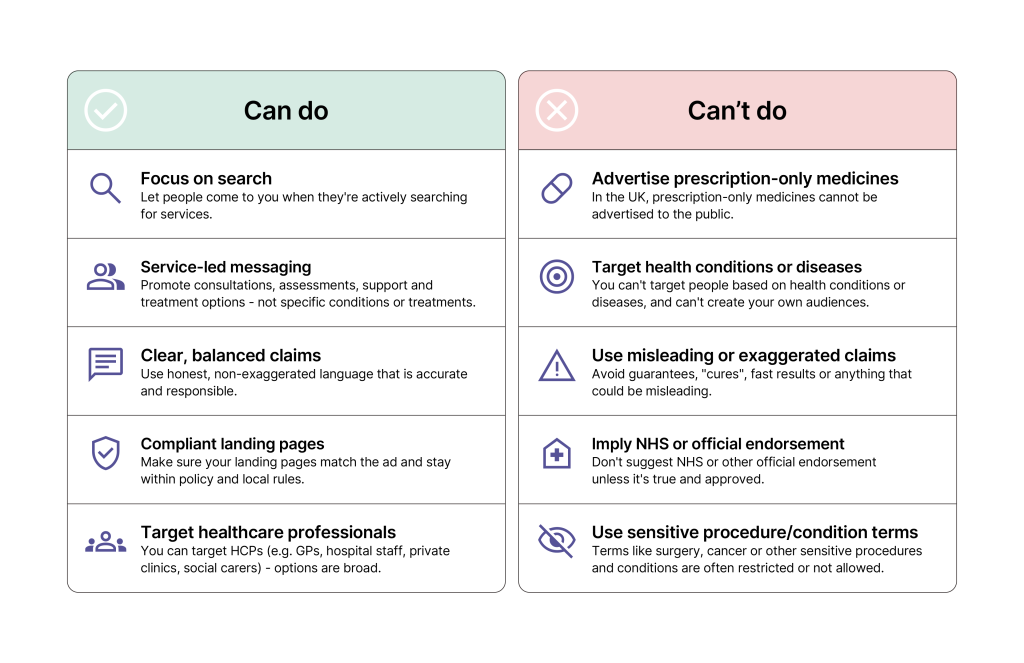
What you generally can’t do
The clearest restrictions tend to fall into a few recurring categories.
In the UK, prescription-only medicines cannot be advertised to the public. That is one of the clearest hard lines. But in practice, the challenge usually goes wider than medicines alone. Sensitive conditions, diseases, services and treatments can also become difficult to target or talk about directly. Things like cancer-related terms or surgery-led terms are the sort of areas where campaigns often run into trouble.
You also need to stay away from misleading or exaggerated claims. In practice, that means avoiding wording that promises certainty, speed or results in a way that feels too strong for a healthcare context.
For example:
Not this: “Guaranteed weight loss in 4 weeks”
More like this: “Clinician-led weight management support”
Or:
Not this: “Cure your back pain fast”
More like this: “Back pain assessment and treatment options”
The second version is still useful. It just is not making a claim that is likely to create problems.
Another area to be careful with is implied endorsement. If the ad or landing page makes it sound like the service is backed by the NHS or another public body when it is not, that can create risk from both a Google policy and UK compliance point of view.
The other big restriction is targeting. You cannot target people based on health conditions or diseases through audience targeting, which means Google does not provide predefined audiences for those kinds of health issues, and you cannot build your own custom versions of them either. That is one of the main reasons healthcare campaigns work differently from many other sectors.
What you can do, if you keep it service-led
The fact that healthcare is restricted does not mean there is nothing you can work with.
In many cases, you can still promote consultations, assessments, services, support, treatment pathways and broader healthcare offerings, provided the messaging stays within the rules. In practice, that usually means focusing on the service or the route into care rather than the most explicit version of the treatment itself.
For example:
Safer angle: “Book a weight management consultation”
Safer angle: “Private GP appointment for migraine support”
Safer angle: “Speak to a clinician about treatment options”
That is often the more workable route anyway. In many healthcare campaigns, the aim is not to say the most explicit thing possible. It is to give enough context for the right person to recognise it is relevant, without pushing the wording into restricted territory.
In my experience, the bigger challenge is often finding the balance. If you strip out too much, the ad becomes vague and loses intent. If you say too much, it can get flagged. So the job is usually to find wording that still feels meaningful without being too direct.
Why Search is usually the safest place to start
For most healthcare advertisers, Search is the most practical place to begin.
The reason is fairly simple. You can usually be there when someone is actively searching for a product or service, but you generally cannot actively target them based on a health issue in the way you might in other sectors. In simple terms, they can come to you, but you cannot really go to them.
That does not mean other campaign types are impossible. Display, YouTube, Demand Gen and Performance Max can all have some use in the right context. But once you move into formats that lean more heavily on audience targeting or automation, things get much harder to control in healthcare.
In practice, that is why most healthcare activity tends to sit in Search. It is intent-led, it is usually easier to justify from a compliance point of view, and it gives you more control over what the campaign is actually matching to.
Why audience targeting is harder than it looks
Audience targeting in healthcare is not just restricted in theory. A lot of the time it is weak in practice as well.
Because you cannot target people based on health conditions or diseases, Google does not offer neat predefined audiences for those kinds of patient needs. And because you cannot create your own personalised health audiences either, a lot of the usual audience-led tactics are not really available.
That leaves you with broader signals, things like demographics or more general targeting approaches. Sometimes that can still work if the product or service has broad enough appeal. Hay fever is a decent example. The affected audience is so wide that broader targeting can still make some sense.
Once you move into something narrower, more specialist or more medically sensitive, it usually becomes much less efficient. You either reach too many irrelevant people, or the message itself becomes too sensitive to use comfortably.
That is another reason Search tends to be the better fit. It lets you respond to real demand, rather than trying to build an audience around a health need that the platform does not really want you targeting directly in the first place.
What about targeting healthcare professionals?
This is slightly different.
You are not dealing with patient health conditions in the same way here, so the targeting conversation changes a bit. But in practice, the audience options are still usually broad. If you are using healthcare professional targeting on more audience-led networks, you can end up hitting a very wide spread of people, including GPs, hospital staff, private clinics and even social care roles. That can be fine in some cases, but if the product or service is niche, it can also lead to a fair bit of wasted spend.
Search is a separate point again. In my experience, many healthcare professionals simply do not search for products and services in especially high volumes through Google, particularly where procurement is formal or handled through other channels. That does not mean Google Ads cannot work for B2B healthcare. It can. But it usually works more as an always-on demand capture channel than as something you switch on for a couple of months and expect to drive large volumes quickly.
That expectation-setting matters. If the search demand is low, that does not make the campaign a failure. It just means it needs judging in the right way.
Which keywords are workable, and which ones cause problems?
This is where healthcare gets messy, because keyword strategy is not just about relevance and search volume. It is also about what Google will let you target at all.
Some terms are clearly too sensitive. Some sit in a grey area. Some broader, service-led terms are often workable even when more condition-led or treatment-led versions are not.
A good example is therapy. Terms like “find a therapist” or “online therapy” can be workable because they are broad and service-led. Terms like “therapy for anxiety” can also be possible. But once you move into something like “therapy for depression”, that is much more likely to create problems because the condition itself becomes part of the targeting logic.
That is where the platform can feel inconsistent from the outside. Some conditions appear to be treated more strictly than others, which is why I would never assume that just because one condition-led term is possible, another one will be too.
The same applies to highly explicit treatment or procedure-led searches. Surgery is a good example. In practice, those kinds of terms are often much harder to use.
A practical way to test keyword viability early
One of the most useful things you can do in healthcare is test keyword viability before putting too much effort into the rest of the build.
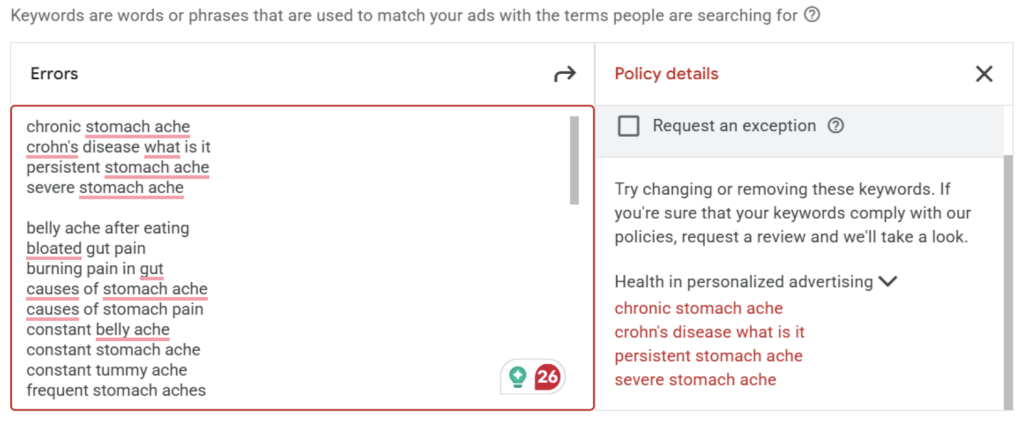
The process is simple. Once the keyword research is done, put the shortlist into a dummy campaign or a single test ad group. The point is not to use that as the real campaign. It is just to save the keywords and let Google tell you which ones are likely to be an issue.
That gives you an early filter. You can then take the remaining terms and build your structure, landing pages, ad copy and assets around what looks realistically usable.
It is a good process, but it is not foolproof. I have seen cases where keywords looked fine at the test stage and then became a problem later once the full campaign was built out. So I would treat it as a useful sense-check rather than a guarantee. Still, it is much better than spending time creating landing pages, writing content, designing assets and building a campaign around terms that were never especially viable in the first place.
Why a targetable keyword can still break the ad or landing page
This is probably one of the most frustrating parts of healthcare Google Ads.
Sometimes a keyword is targetable, but using that same wording in the ad or on the landing page is too explicit. In the UK especially, that often happens where the intent is around a sensitive treatment, condition or medicine, but the public-facing wording still needs to stay broader.
So you end up in a slightly awkward position. The user intent may clearly be about a specific treatment or condition, but the ad needs to say something more like:
“Book a consultation”
“Speak to a clinician”
“Explore treatment options”
From a performance point of view, that is not ideal. Normally, you would want a close relationship between keyword, ad copy and landing page. In healthcare, that relationship is often looser because you cannot always mirror the exact term directly.
That can affect keyword quality score as well. If you cannot safely use the same wording in the ad or on the page, you lose some of that neat alignment you would normally aim for.
Where healthcare campaigns usually get tripped up
A lot of healthcare campaigns do not fail because someone tried to do something reckless. More often, one part of the setup is fine on its own, but the whole thing does not hold together once Google reviews the ad, the page and the targeting together.
A common example is an ad that is relatively careful, but the landing page says much more than the ad does. Another is a campaign that is technically live, but is marked as limited by policy because of the topic or the way the campaign is set up.
There is also the practical side of match types and automation. In healthcare, we tend to stay away from broad match unless there is a very good reason not to, because intent can drift quickly into irrelevant or unsafe territory.
Performance Max is another example. In my experience, in healthcare accounts it often ends up serving mainly on Search anyway, which is another reason I would usually rather just run a standard Search campaign and keep things more controlled.
The UK points that matter most
If you are advertising healthcare in the UK, a few issues matter more than almost anything else.
First, prescription-only medicines cannot be advertised to the public. That is the clearest hard line, but it is not the only one. In practice, the wider issue is that public-facing healthcare advertising in the UK needs to be handled carefully where the topic involves sensitive conditions, named medicines, treatment pathways or services that could lead to prescription use.
Second, you need to think about entry points, not just ads. One of the things that catches businesses out is focusing on the ad while forgetting the homepage or landing page. If the page says too much, it does not really matter how careful the ad was.
Third, certification and registration can matter depending on the model. Online pharmacies and some telemedicine services may need specific registrations and Google healthcare approvals before advertising.
And finally, Google approval is not the same as legal clearance. Even if a campaign runs, UK healthcare rules still apply.
A practical pre-launch checklist
Before building the full campaign, it is worth pressure-testing a few basics.
What exactly are you advertising: a service, a consultation, a product, a device, or a pathway that may lead to treatment?
Are any of your preferred keywords likely to be too sensitive or too condition-specific?
Have you tested the keyword list inside Google Ads before finalising the campaign plan?
Does the ad preserve intent without relying on wording that is likely to get flagged?
Does the landing page quietly say things the ad avoids saying?
Are you leaning on audience tactics that are not really suitable for a health-sensitive topic?
If the audience is healthcare professionals, is the search demand actually there?
If the offer is niche, are expectations around scale realistic?
If certification or registration is relevant, is it already in place before launch?
The main thing is to validate viability early. It is far better to discover the limits before you have built landing pages, written content, designed assets and structured the campaigns than afterwards.
FAQs
Can clinics advertise on Google Ads?
Yes, often they can, as long as the campaign, landing page and targeting all stay within Google policy and the relevant local rules.
Can you advertise prescription-only medicines on Google Ads in the UK?
Not to the public. In the UK, there are clear restrictions around publicly advertising prescription-only medicines.
Can healthcare advertisers use remarketing?
In patient-facing healthcare, personalised audience targeting is heavily restricted. That is one of the main reasons most healthcare campaigns rely far more on Search than on audience-led retargeting strategies.
Can you target surgery, cancer or other sensitive procedures and conditions?
Often not directly, or at least not comfortably. Sensitive procedures, diseases and treatment-led terms are some of the areas most likely to create issues, which is why broader, service-led wording tends to be the safer route.
Is Search usually better than Display or YouTube for healthcare?
In many cases, yes. Search is usually easier to manage because it lets you respond to active intent rather than trying to target people around a sensitive topic.
Can you target healthcare professionals on Google Ads?
Sometimes, yes, but the options can be broad, and the search demand is often lower than people expect. In many cases, it works better as an always-on B2B demand capture channel than as a high-volume growth play.
Final thought
The simplest way I would put it is this: healthcare Google Ads is rarely just about whether you can advertise. It is more about whether you can advertise in a way that is compliant, commercially sensible and still clear enough to perform.
Usually, the best route is also the least dramatic one. Start with Search, keep the message service-led, test the keyword list early, be realistic about audience targeting, and treat policy as part of the strategy rather than something to check once everything has already been built.