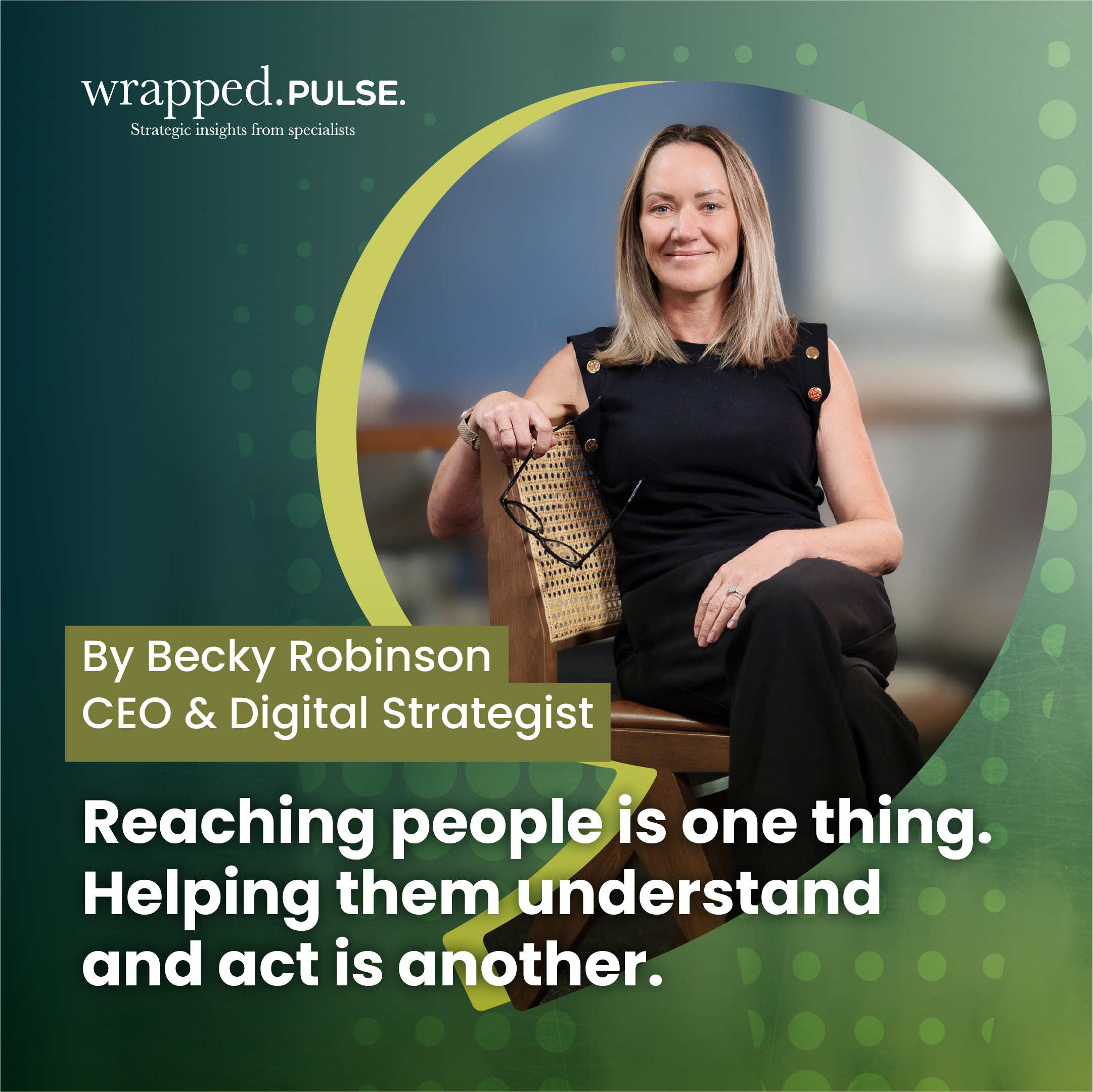

By Becky Robinson, CEO & Performance Strategist at Wrapped Agency
Why effective marketing in high-trust sectors is about more than reach, engagement and conversion.
In marketing, we’re surrounded by numbers. Audience sizes, impressions, website traffic, engagement rates and conversions. They’re important measures of performance, but they don’t always tell us whether our communications have actually worked.
Having spent more than 20 years developing marketing strategies, particularly in healthcare and other high-trust sectors, I’ve seen how easily success can become defined by the number of people reached rather than what those people have understood or been able to do as a result.
For many of the organisations we work with at Wrapped, the objective isn’t necessarily to reach the largest possible audience. It’s to make sure the right people receive information they can understand and act on.
That might mean communicating detailed clinical evidence to a small group of healthcare professionals, helping someone understand a financial commitment or making sure a person who needs support knows how to access it.
All require a different approach, but they have something in common. The success of the communication depends on what the audience can do with the information, not simply whether they’ve seen it.
The right information, for the right audience
Take a medical device company trying to communicate new clinical evidence to healthcare professionals. The audience might be a relatively small group of clinicians involved in recommending or using a particular treatment. Those clinicians need detailed evidence, clinical outcomes, methodology and limitations to assess whether the device is appropriate for their patients.
A well-researched clinical white paper, distributed through relevant professional channels, could therefore be considerably more valuable than a broad awareness campaign reaching thousands of people who have no involvement in those decisions.
But a patient considering the same device will probably have very different questions. They might want to understand what it does, how it’s used, whether there are risks and what they can expect from treatment.
Both audiences need accurate information, but the language, format and level of detail should reflect their needs. That might mean developing a clinical white paper for healthcare professionals alongside patient information written in plain English, an Easy Read guide or an explanatory video.
We see similar considerations in finance and fintech. A financial professional evaluating a new payment technology may need detailed information about security, integrations, regulation and commercial implications. Someone using a financial product for the first time may need a clearer explanation of what they’re agreeing to, what it will cost and what happens if their circumstances change.
Good communication isn’t always about reducing complexity. Sometimes it’s about retaining the detail people need but presenting it in a way they can navigate and understand.
And that’s why I think we need to look beyond how many people we’ve reached and consider whether we’ve given them the information they actually need.
Sometimes it’s the circumstances, not the information, that make understanding difficult
I think this is an area that marketing teams can easily overlook.
We tend to think about accessibility in relation to the language we use, reading ability or whether someone has a disability. Those are all important considerations, but people’s ability to process information can also change depending on what’s happening in their lives.
Someone who’s just received a serious medical diagnosis might find it difficult to absorb information they would normally understand without any problem. They may be anxious, frightened or overwhelmed, and need time to process what they’re being told.
Someone facing financial difficulties might struggle to concentrate on the details of a repayment arrangement, even if the explanation itself is relatively straightforward.
A person trying to find support through a charity may be dealing with grief, uncertainty or a particularly difficult personal situation. Someone making decisions about housing could be under considerable pressure, particularly if they’re facing a change in their living circumstances.
There are also more permanent or ongoing barriers to consider. Someone may have a learning disability, a cognitive impairment or a visual impairment. They may not speak English as their first language, or they may need information in a different format to understand it independently.
We can’t assume that someone will understand and act on information simply because we believe we’ve explained it clearly. We need to consider the circumstances in which they’re receiving it and what might make it difficult to process.
That could mean providing information in stages, using supporting visuals, offering different formats or making it easier for someone to return to important details later. It might also mean changing the way we ask people to take the next step.
Helping people feel able to act: the You Can Ask campaign
A good example of this approach is the You Can Ask campaign we developed for West Yorkshire and Harrogate Cancer Alliance.
The campaign was designed to encourage more women with learning disabilities, women who speak English as a second language and women experiencing serious mental health difficulties to attend breast screening appointments. These groups had been identified as having lower screening attendance, so we needed to understand what was preventing them from attending and how our communications could help address those barriers.
Before developing the campaign, we carried out three focus groups, one with each audience. We wanted to understand what women already knew about breast screening, what concerns or practical barriers might prevent them from attending, and how they wanted the campaign to look and feel.
This research was an important part of the process because we didn’t want to assume that the same approach would work for everyone, or that the barriers to attendance would be the same across all three groups.
The campaign centred around a relatively straightforward message: women could ask for reasonable adjustments at their breast screening appointment to make the experience more accessible and comfortable. But we knew that simply putting that message into an advertising campaign wouldn’t necessarily be enough to encourage attendance.
We developed a multichannel approach that considered not only the women we wanted to reach, but also the people and organisations who could help them access and understand the information. This included carers, community leaders and healthcare professionals.
Community centres were particularly important. We engaged with them through social media, explained the campaign and provided physical information packs they could share directly with women in their communities. We also supplied social media assets for organisations to publish through their own channels, helping the message reach friends, families and wider support networks.
Alongside this, we reinforced the campaign branding and messaging in physical locations to build familiarity and recognition. We also created You Can Ask stickers for people and organisations who wanted to show their support and help spread the message.
What I particularly like about this campaign is that the information itself wasn’t especially complicated. The challenge was understanding what might prevent different groups of women from attending breast screening and finding ways to make the message accessible, familiar and reassuring.
The focus groups gave us a much better understanding of the audiences before we made decisions about the creative, messaging and delivery. And by working with community organisations, carers and healthcare professionals, we were able to reach women through people and places they already knew.
By the end of the campaign, breast screening attendance had increased by 12.5% (in Pudsey, Leeds)
For me, this demonstrates why research and audience understanding are so important. The message might be straightforward, but getting it to the right people, in a way that gives them the confidence to act, requires considerably more thought.
Format, design and channel are part of the message
When developing a marketing strategy, there’s often a lot of discussion about channels. Should we use social media, search, email, PR or a combination of approaches?
But before deciding where a message should appear, I think we need to consider how the audience will best understand it.
For a healthcare professional, a detailed clinical document may be exactly what’s required. For a patient, a short video explaining what happens during an appointment could be much more useful.
A charity communicating with people who have learning disabilities might need Easy Read materials that combine clear language, supporting images and accessible layouts.
In financial services, a visual explanation of how interest accumulates or how repayment options differ could be more helpful than several paragraphs of technical wording. In property, a clear breakdown of costs and stages in the buying process could help people understand what they’re committing to.
These aren’t simply creative decisions. They affect whether the communication works.
Design plays a significant role too. Typography, contrast, layout, imagery and the way information is organised can all influence how easily people understand what they’re reading.
And the channel matters. We need to consider where the audience is likely to look for information, which sources they trust and whether the format is appropriate for how they’ll access it.
An important message delivered through the wrong channel, or in a format the audience can’t use, may never achieve its purpose, however well written it is.
The user journey can be the biggest barrier
Something we consider regularly when developing websites and digital strategies at Wrapped is what happens after someone receives the message.
It’s possible to produce clear, accessible content and still create a user journey that makes it difficult for people to act.
Someone might understand the information about a healthcare service but struggle to book an appointment because the only option is to telephone. Someone seeking financial support might find a helpful explanation of the options available but then be directed into a complicated application process.
For a charity, the challenge might be making sure someone can find the right support without navigating several pages of information or repeatedly explaining their circumstances.
And in property, someone might be interested in a development but struggle to find the information they need about accessibility, costs or the practicalities of moving.
These are all situations where the message itself may be perfectly understandable, but the wider experience creates barriers.
This is why I think good user experience is about more than reducing the number of clicks or making journeys as short as possible.
Sometimes people need more information, more reassurance or the opportunity to consider their options before making a decision. Removing those stages in the name of efficiency can actually make the experience worse.
The objective should be to make the journey appropriate for the audience and the decision they’re making.
Research tells us what we don’t already know
One of the challenges of working within a business or organisation is that you become very familiar with your own subject.
You know the terminology, understand how the service works and recognise which details matter. It’s easy to forget that the people you’re communicating with may not have the same knowledge or experience.
At Wrapped, we look at audience behaviour, search patterns, competitor activity and the questions people are asking. But depending on the project, we also need to understand the circumstances in which people access information and what might prevent them from using it.
That could mean speaking directly to the intended audience, working with organisations that support them or testing different approaches to communication.
For example, research might reveal that patients interpret a clinical phrase differently from healthcare professionals. Or that customers recognise a financial term but don’t fully understand its implications.
It might also show that the information itself is clear, but the way it’s presented or the process that follows is causing difficulties.
Importantly, we shouldn’t make assumptions about what people need based solely on their age, background or disability. Different people have different preferences and requirements, and involving them in the development process is often the best way to understand those differences.
Sometimes the research will tell us to simplify something. Other times, it will tell us that people want more detail, a different format or a clearer explanation of what happens next.
Are we measuring the right outcomes?
I’m not suggesting we move away from data-driven marketing. We need evidence to understand whether our strategies are working and where improvements are needed.
But in high-trust sectors, I think we should be asking more questions about what success actually looks like.
If we’ve developed patient information, can people understand what it means for them? If we’re communicating a financial product, do customers understand the terms and implications before making a decision? If a charity is promoting a support service, can the people who need it find and access that support?
Those outcomes might be measured through user testing, feedback, task completion, service enquiries or changes in behaviour.
They won’t always produce impressive numbers in a marketing dashboard, particularly when we’re communicating with smaller or more specialist audiences.
But they can tell us much more about whether the work has achieved its purpose.
For me, that’s an important part of marketing accountability. We should be able to explain not only how many people we reached, but whether our communications helped them understand something or take an appropriate action.
Making information genuinely useful
For organisations working in healthcare, finance, fintech, property and charities, the information we communicate can influence some very important decisions.
Getting it right means understanding who needs that information, what they need from it and the circumstances in which they’ll receive it. That might lead us towards detailed technical content, Easy Read materials, a different creative approach or a completely different user journey.
We should still measure reach, engagement and conversions. But we also need to understand whether people have understood the message and can take the next step.
Because ultimately, reaching someone is only useful if the communication does what it was intended to do.