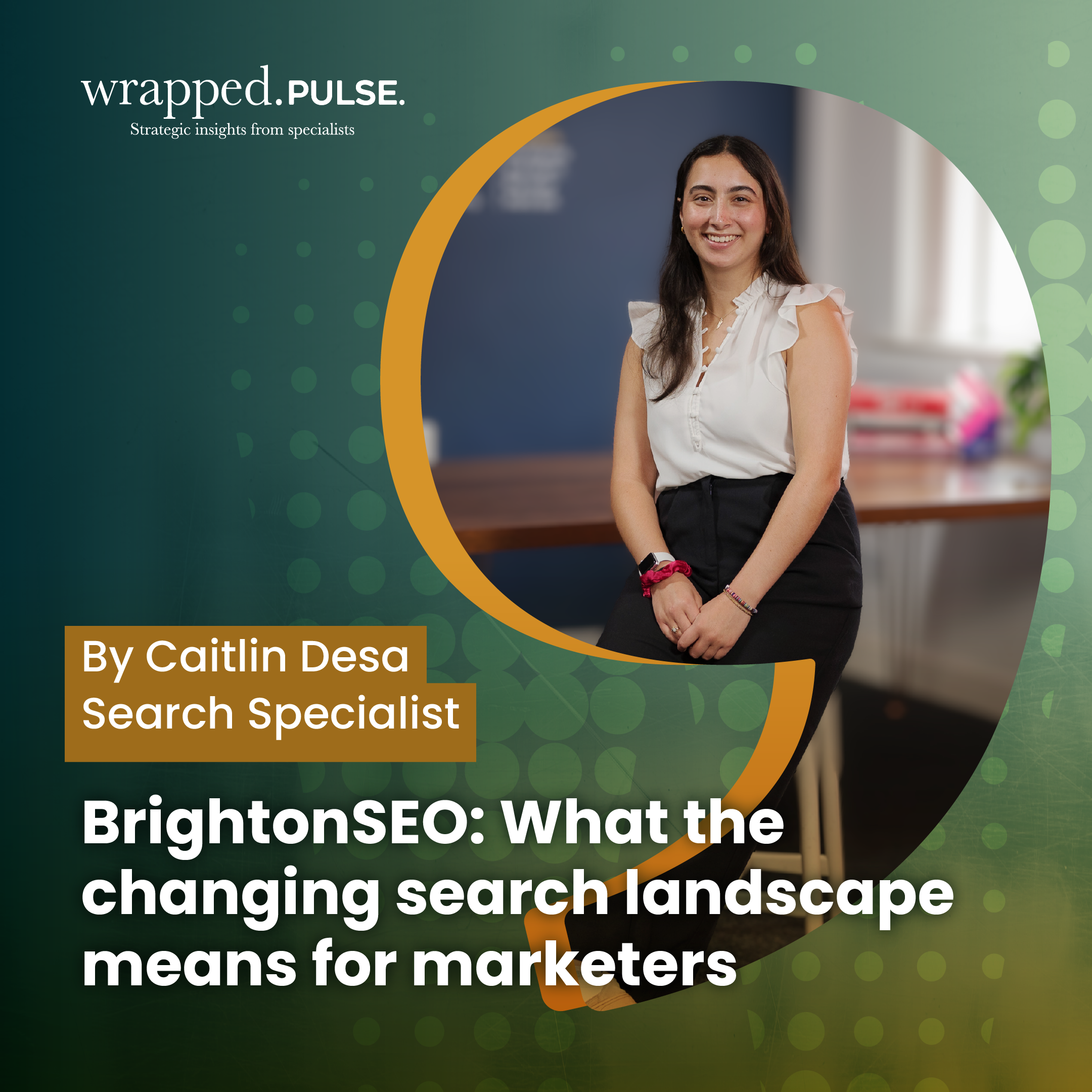

By Caitlin Desa, Search Specialist at Wrapped Agency
At the beginning of October, Wrapped Agency attended BrightonSEO, one of the world’s largest search marketing conferences.
Across two days, we had the opportunity to explore some of the biggest changes taking place across SEO, generative AI and the wider search landscape, alongside marketers sharing new research, practical insights and different perspectives on where search is heading.
We began with drinks and networking with the AgencyLand Network, before moving into a packed conference schedule. We also caught up with the Peec AI team to discuss the changing relationship between traditional SEO and generative AI. I spoke about how we use the platform at Wrapped to understand AI visibility and brand sentiment, and how that insight can help shape wider search strategy.
There was even time for a game of Call of Duty, although my performance there probably needs more optimisation than our search campaigns.
Beyond the networking and conversations, the conference reinforced something that is becoming increasingly difficult for marketers to ignore: search is no longer confined to Google.
Search is becoming more fragmented
The traditional search journey was once relatively easy to visualise. A user discovered a need, researched possible solutions, compared providers and eventually converted.
That journey is becoming far less linear.
People are now discovering brands and researching decisions across AI assistants, social media, Reddit, YouTube and other platforms before they ever arrive on Google. In some cases, Google is becoming the place where users validate or act on a decision they have largely made elsewhere.
That has significant implications for marketers.
If someone arrives through a branded or high-intent Google search after already researching the company through ChatGPT, Reddit or social media, Google Search is only one part of the journey that influenced the conversion.
SEO strategy therefore has to consider a much broader discovery environment. And that naturally raises another question: if search is spreading across more platforms, what does that mean for SEO itself?
So, what happens to SEO?
One thing became very clear at BrightonSEO: nobody has a definitive answer to what search will look like several years from now.
That is not a reflection of a lack of expertise. The landscape is simply moving too quickly.
LLM platforms are changing constantly, user behaviour is becoming more fragmented and new features can alter how people discover information almost overnight.
What there was much more agreement on, however, was that businesses should not abandon established SEO best practice.
Technical accessibility, useful content, clear site structures, authority and strong user experiences remain important. The platforms may change, but the need to create information that can be found, understood and trusted does not.
The shift, therefore, is not about replacing SEO principles. It is about applying them more broadly across the increasingly fragmented places where people search.
SEO principles are spreading across channels
One of the themes that appeared repeatedly throughout the conference was Google’s concept of E-E-A-T: Experience, Expertise, Authoritativeness and Trustworthiness.
These principles have traditionally been discussed in relation to organic search, but they make sense across a much wider discovery ecosystem.
Reddit users are more likely to trust genuine expertise than obvious promotional content. Social video needs to be accessible and understandable. AI systems need clear, reliable information if they are going to represent a brand accurately.
Even relatively small optimisation opportunities still matter. Ensuring images have meaningful alt text improves accessibility and gives search systems additional context. Keeping content accurate and up to date makes it more useful to both users and AI systems. Keywords still help platforms understand what a piece of content is about, whether they appear within website copy, social posts or other forms of content.
The principle is not to force traditional SEO tactics onto every channel. It is to understand why those practices work and apply the same thinking appropriately elsewhere.
This becomes particularly important in specialist and regulated sectors. Healthcare SEO needs to consider how patients and professionals research medical information, while financial services and fintech SEO must account for the importance of accuracy, trust and regulatory requirements. The same principles apply to property marketing, where buyers research developments across multiple platforms, and charity marketing, where supporters may discover a cause through social content before searching for more information. Effective search strategies need to reflect these different journeys, rather than treating every audience or industry in the same way.
However, being discoverable across more channels only solves part of the problem. Once a brand appears, it still needs to give the audience a reason to remember it and choose it later.
Being visible is not the same as being memorable
This came through particularly strongly in discussions around social media.
For years, success has often been framed around reach, engagement and the possibility of going viral. But, visibility alone does not necessarily create commercial value.
The more useful question is whether somebody remembers the brand afterwards.
That requires more than publishing information. Content needs to combine useful information with something that creates interest, emotion or recognition.
The same principle increasingly applies across the wider search journey.
As search becomes more fragmented, understanding what makes an audience notice, remember and eventually choose a brand becomes increasingly important. Visibility can tell you where people are finding you; customer insight helps explain what they actually need when they get there.
Know your customer before the dashboard tells you something has changed
One of the talks that stood out to me most focused on understanding your customer and your industry deeply enough to anticipate change.
Marketers spend a significant amount of time monitoring dashboards for changes in clicks, conversions, demand and other performance indicators.
The problem is that by the time a metric has changed, the underlying behaviour has often already shifted.
The better businesses understand their market, seasonal patterns and customers, the better chance they have of responding earlier.
This means knowing when demand typically rises and falls, paying attention to emerging customer questions and understanding what is happening within the wider industry.
It also means treating marketing as a two-way source of insight.
Search behaviour can tell businesses what customers want, not simply how well a campaign is performing.
If customers repeatedly search for a version, feature or service that the business does not currently offer, that information could be commercially valuable beyond the marketing team.
Sometimes the right response is not another campaign optimisation. It is improving the product or service.
For me, this reinforced a wider takeaway from the conference: as search becomes more complex, understanding changing customer behaviour matters just as much as understanding the platforms themselves.
The fundamentals have not disappeared
After two days of conversations about AI search, social discovery, LLM optimisation and emerging technology, my biggest takeaway was surprisingly straightforward.
We do not need to completely reinvent the SEO wheel.
Search is undoubtedly changing, and marketers need to understand how discovery is spreading across different channels. Yet, the fundamentals remain remarkably consistent.
Create useful information. Understand your audience. Demonstrate genuine expertise. Make content accessible. Keep information accurate. Build trust. Measure what matters.
Then apply those principles wherever your customers are searching.
BrightonSEO made it clear that there is still a huge amount of experimentation taking place around the future of search, and there will be plenty more change to come.
For marketers, the challenge is not predicting every new platform or trend correctly. It is building a search strategy flexible enough to adapt as customer behaviour changes, without losing sight of the fundamentals that made good SEO effective in the first place.