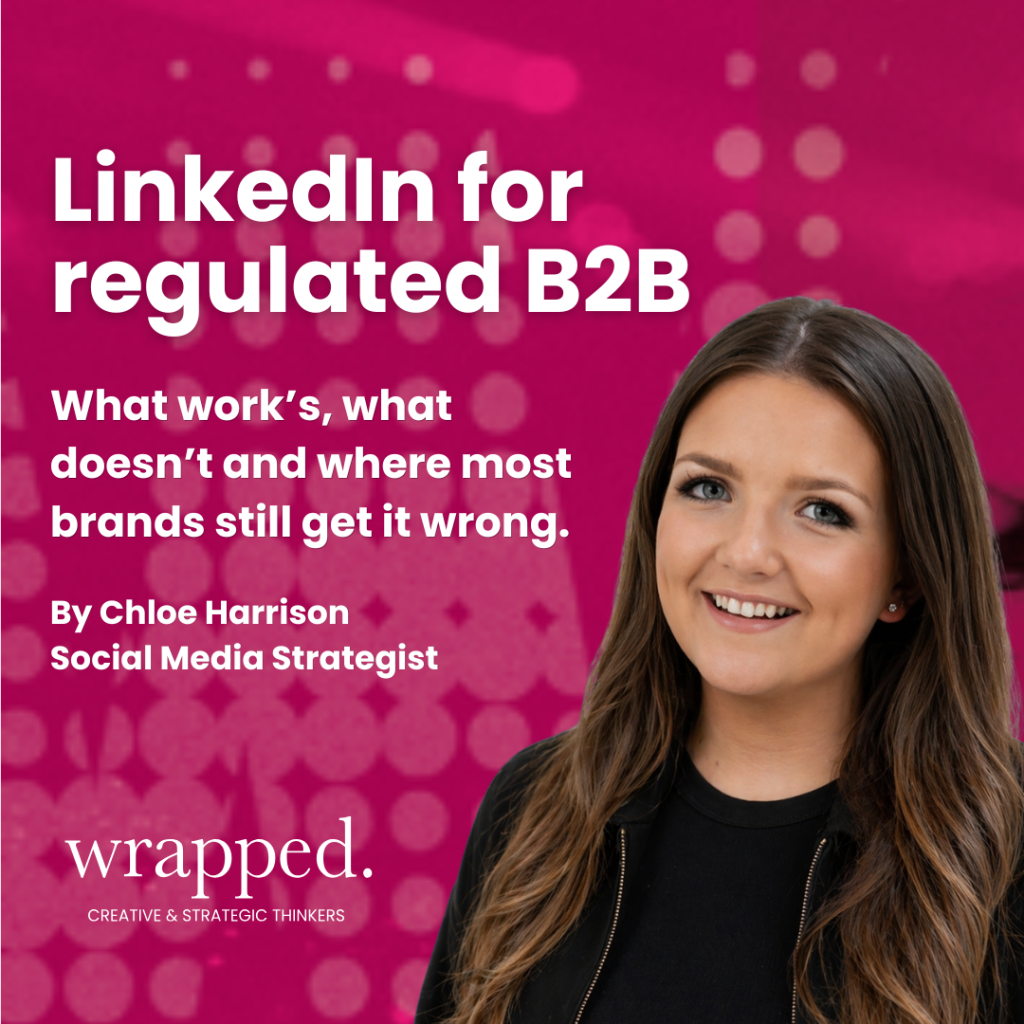

By Chloe Harrison, Social Media Strategist at Wrapped Agency
Posting on LinkedIn in a regulated industry is a balancing act. You need to be credible. Useful. Compliant. But you also need to be interesting.
Most brands manage risk by playing it safe. The result is content that says very little and gets ignored.
From our work across regulated sectors, the brands that actually grow on LinkedIn take a different approach. They don’t use it as a promotional channel. They use it to interpret complexity.
The problem isn’t compliance. It’s caution.
A lot of LinkedIn content in regulated sectors isn’t wrong. It’s just not useful. We consistently see the same patterns:
- Safe updates with no clear takeaway
- Overly technical language that loses the audience
- Posts that repeat what’s already known
Content designed to avoid risk rather than create value
In trying to say nothing wrong, brands end up saying nothing meaningful.
The shift: from promotion to interpretation
The content that performs isn’t louder. It’s clearer. It helps the audience understand what’s happening, what it means and what to do next.
That shift matters, especially in regulated industries where the subject matter is complex.
You’re not there to promote. You’re there to translate.
What this looks like in practice
A good example of this is our work with Carelight Weartech.
Their product is built on complex clinical technology, including multispectral sensing and opto physiological monitoring. At first glance, it’s not something that translates easily into social content.
But that’s exactly where the opportunity sits.
Instead of simplifying the message to the point it loses meaning, we focused on making it understandable.
Through a series of LinkedIn posts using video and carousel formats, we broke the technology down into clear, digestible insights. Explaining what it does, why it matters and how it improves patient outcomes.
For example, content focused on:
- How monitoring performs across different skin tones
- Why signal quality matters in clinical decision-making
- The real-world limitations of traditional devices
Each post tackled a single idea, grounded in evidence and explained in plain English.
The result wasn’t just engagement. It was understanding. And that’s what builds trust in regulated sectors.
You don’t need to share client info to show expertise
One of the biggest blockers in regulated marketing is the fear of saying too much. But strong content doesn’t rely on client detail. It relies on pattern recognition.
Across the brands we work with, we see the same challenges repeatedly. Delays at compliance sign-off. Misalignment between teams. Underestimating how long approvals actually take.
Sharing those patterns builds authority without breaching confidentiality. It shows you’re close enough to the work to understand where things actually break.
Why clarity outperforms cleverness
LinkedIn rewards content that is easy to understand and easy to act on. That’s especially true in regulated sectors.
The posts that perform best aren’t the most creative. They’re the most useful. Clear observations. Simple explanations. Practical takeaways.
If someone can read your post and immediately understand something they didn’t before, it works.
Where most brands still get it wrong
The biggest mistake is treating LinkedIn as a place to broadcast updates. New hires. New services. New announcements.
There’s nothing wrong with that content. It just doesn’t build authority on its own. Your audience isn’t looking for updates. They’re looking for signals.
- Do you understand their world?
- Can you simplify complexity?
- Do you have a point of view worth listening to?
What LinkedIn is really doing for your brand
In regulated B2B, LinkedIn isn’t just a channel. It’s part of your credibility.
Before speaking to you, buyers are already forming a view. They’re looking at your content to understand how you think, how clearly you communicate and whether you actually understand their challenges.
From what we see across regulated sectors, that validation is happening earlier and more often.
Which means your content isn’t just marketing. It’s part of the buying decision.
Final thought
LinkedIn in regulated sectors isn’t about saying more. It’s about saying something useful.
The brands that perform aren’t the loudest. They’re the clearest.
Because when the subject matter is complex and the stakes are high, clarity is what builds trust.